AÇEV Holds 'Involved Fatherhood' Workshop with Private Sector Executives

AÇEV organized a workshop titled "Supporting Involved Fatherhood in Partnership with the Private Sector" with business executives to introduce its campaign aimed at encouraging fathers to take an active role in childcare and strengthening the understanding of equal parenting in society.
Hasan Deniz, Director of Corporate Partnerships and Advocacy at AÇEV, said, "The direct interactions that the private sector establishes with society play a very important role and have significant impact in supporting equal parenting."
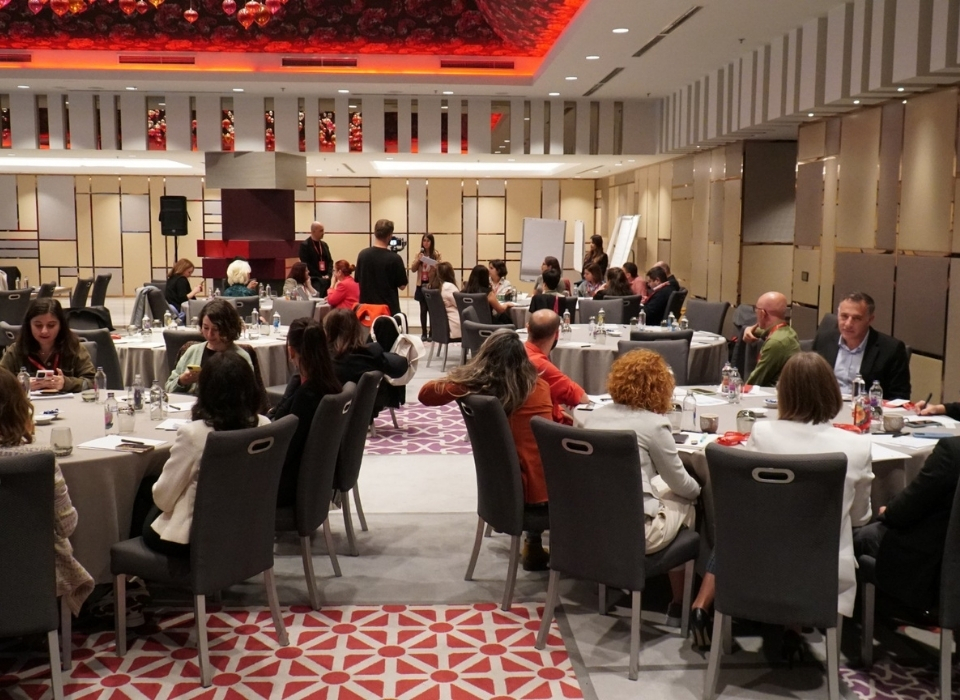
The Mother Child Education Foundation (AÇEV) has been developing and implementing scientific programmes for children, parents and young women for 30 years to ensure that every child is happy, safe, healthy and learning. It has continued implementing the Father Support Programme since 1996 to establish the concept of "involved fatherhood." In partnership with Equimundo, a leading international civil society organization in this field, AÇEV launched a new campaign called "Equal in Parenting." In line with this campaign, which was launched to encourage and promote fathers taking equal responsibility in children's education, care and development and building a mutual and close relationship with their children, a workshop was held with private sector executives. The workshop titled "Supporting Involved Fatherhood in Partnership with the Private Sector" featured senior executives from Mustela Turkey, Vodafone Turkey, CISCO and Fiba Group as panel speakers, while human resources and corporate communications specialists from Turkey's leading companies participated in the event, which continued with working sessions. The workshop addressed the private sector's impact on perceptions of fatherhood and masculinity and the private sector's role in promoting the understanding of equal parenting, and exchanged ideas on corporate solutions.
'The private sector is crucial for change'
Hasan Deniz, Director of Corporate Partnerships and Advocacy at AÇEV, opened the workshop held on 25 October. He emphasized that involved fatherhood was defined as a parenting attitude in which fathers "take responsibility in the physical care of their children, support their development, develop a mutual and close relationship with their children and do not exhibit any form of violence." Highlighting that AÇEV's Father Support Programme, which has been implemented since 1996, has reached over 100,000 fathers, he said: "We all know that fatherhood cannot be transformed through individual change among fathers alone. The phenomenon of fatherhood is influenced by many diverse factors such as politics, work life and employment. The private sector's direct interactions with society through arrangements such as paternity leave, workplace childcare, and training provided to employees, and through tools such as products, advertising and campaigns, play a very important role and have significant impact in transforming fatherhood. Particularly in the promotion of products and services aimed at children and childcare, in advertising, in the instructions and explanations coming from the products, it is very important to address fathers as much as mothers and emphasize that they have responsibilities in childcare."
What are men saying?
Dr. Gary Barker, founder president and CEO of Equimundo, which has conducted important work worldwide on fatherhood and gender issues, joined the workshop remotely. In a presentation titled "Men's Role in a World with Gender Balance," Barker emphasized that, contrary to what is thought, fathers also want to take on childcare, that men who participate in childcare feel happier and develop better relationships with their children. Barker also noted that there are studies showing improvements in the health status of men who participate in childcare and spoke of research conducted by Equimundo every two years. Barker said, "In our research on fathers' participation in childcare, we found that men, just like women, demand arrangements such as the opportunity to take paid leave to care for their children, childcare assistance and support for low-income families. Therefore, we actually don't need to convince men of these changes; men already know that these changes will be beneficial for them too. What we really need to do is convince them to loudly demand these changes. On the other hand, just as women prepare for motherhood through the hormonal and chemical changes they experience during pregnancy, childbirth and breastfeeding, men who develop close relationships and communication with their newborn babies also experience some changes in their brains and bodies. The task for the private sector in this era of transformation is to listen to men when making workplace gender equality and childcare arrangements, and create spaces where they can express their own needs. This way, men can participate willingly in these processes and adopt these arrangements. It is as important to prepare men for what they will do during paternity leave as it is to encourage them to take it. At this point, male managers in particular can serve as role models; by taking parental leave or leaving early to pick up their child from school. Many men cannot use these leaves because they fear their managers."
Panel and workshop session held
Following the opening remarks, a panel was held titled "Involved Fatherhood and Shared Care: Experiences That Encourage Us." Fikret Baltaoğlu, General Manager of Laboratoires Expanscience Turkey & Regional Manager for Africa, Middle East and Asia Pacific, Didem Duru, General Manager of CISCO Turkey, Romania and CIS Region, Aylin Kurt Ganiç, Corporate Communications Director of FİBA Group and Hicran Bakalcı, Director of Technology, HR Partnership & Organizational Efficiency at Vodafone Turkey, described the work their companies have done in the area of gender equality. The workshop concluded with a working session titled "The Private Sector's Role in Supporting Involved Fatherhood: What Have We Done and What More Can We Do?" facilitated by clinical psychologist Serkan Kahyaoğlu. Participants gathered around a table to exchange ideas and then shared their suggestions in brief presentations.
AÇEV invites private sector stakeholders, who play an important force and role in promoting understanding of equal parenting and involved fatherhood, to make the useful steps they are taking within their companies and in their relations with the public more visible by presenting good examples and thereby encouraging other companies. It also emphasizes once again the importance of taking steps such as increasing paternity leave in line with the structure and needs of their institutions, encouraging fathers to actively care for their children during these leave periods, creating remote and flexible work opportunities to increase father participation, building a language and culture within the organization that embraces equality in parenting responsibility and involved fatherhood, and paying special attention to emphasizing father's care responsibility in all communication activities related to children and childcare products.
Gallery