Structure-Property Relationships of Polymers Used in Automatic Dishwasher Detergents

Abstract
In this study, the effects of different polymer systems used as anti-filming agents in automatic dishwashers on film formation on glass surfaces were investigated. In addition to standard polyacrylates, the effects of the structural properties of polymaleic acid (PMA) and polyaspartic acid (PASA) alternatives on film formation were tested. The results obtained show that low molecular weight polyacrylates maintain their effectiveness in formulations, while alternative polymers with different chemical structures can constitute innovative alternatives to conventional lime scale inhibitors.
Introduction
When calcium ions in wash water come into contact with the sodium carbonate present in detergent formulations, they can precipitate on surfaces such as glass and plates, forming a visible film layer. In order to prevent this precipitation process, metal-binding agents (e.g., amino carboxylates) that directly bind calcium ions, chelating agents that inhibit the crystal growth of calcium carbonate, and polyacrylates that bind to calcium carbonate at an early stage and slow down crystal growth are used. The film formation mechanism of calcium carbonate basically consists of the stages of ion clustering, nucleation, growth, and deposition on the surface. To halt this mechanism, metal-binding agents prevent the initial nucleation, while chelating agents and polymers inhibit crystal growth and aggregation [1].

Figure 1. Calcium carbonate film formation mechanism: Clustering, nucleation, crystal growth
In this study, the performance of polyacrylates with different molecular weights, which are widely used in the industry as calcium-binding and anti-redeposition agents, was first examined. Subsequently, two different polymer systems (PMA and PASA) were evaluated structurally as potential alternatives.
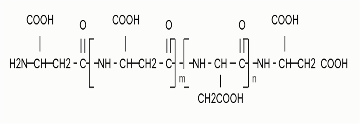
Figure 2. Chemical structures of polyacrylate, polymaleic acid (PMA), and polyaspartic acid (PASA) polymers
Methods Used
Within the scope of the study, the effects of the molecular weight and chemical structures of the polymers on film formation on glassware were investigated. The test process was carried out over 30 consecutive wash cycles, and the appearance of the glassware was evaluated every 10 washes. Standard soil load, 37 °fH water hardness, and 55 °C washing temperature parameters were used in all washing trials. After each evaluation stage, the glassware was illuminated under white light; filming levels were visually rated on a scale of 1 to 9. In this scoring, 1 indicates the worst result and 9 indicates the best.
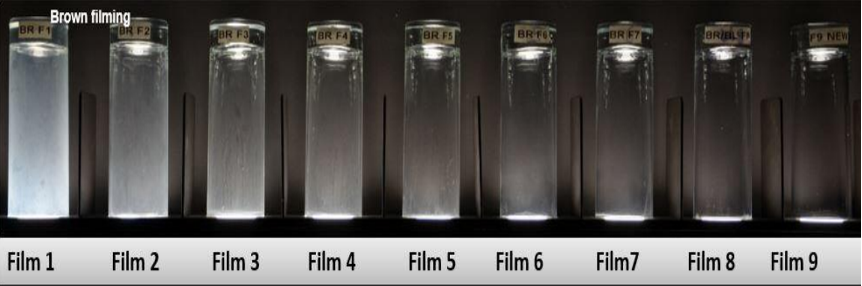
Figure 3. Filming evaluation scale
Results and Discussion
In standard polyacrylates, an increase in molecular weight increases film formation, thereby reducing performance.

As seen in Table 1, while the 2000 g/mol variant scored 7 points, the 8000 g/mol variant fell to 5.5 points. When alternative polymers were examined, it was observed that polymaleic acid (PMA) with a molecular weight of 1000 g/mol matched the standard film levels. When biodegradable PASA was used, it was observed to exhibit performance equivalent to the standard formulation, with a score of 7 points.

CONCLUSION
While low molecular weight (~2000 g/mol) polyacrylates maintain standard performance, alternative polymers such as PMA and PASA also offer similar effectiveness in preventing limescale and filming. This indicates that the surface adhesion and stain prevention properties of different polymer classes can be explored for optimization in the future.
REFERENCES
1. Chauhan, K., Sharma, P., & Chauhan, G. S. (2015). Removal/dissolution of mineral scale deposits. In Z. Amjad & K. D. Demadis (Eds.), Mineral scales and deposits: Scientific and technological approaches (pp. 701-720). Elsevier. https://doi.org/10.1016/B978-0-444-63228-9.00029-2
Gallery
Advertisement
Ad Space728 × 90