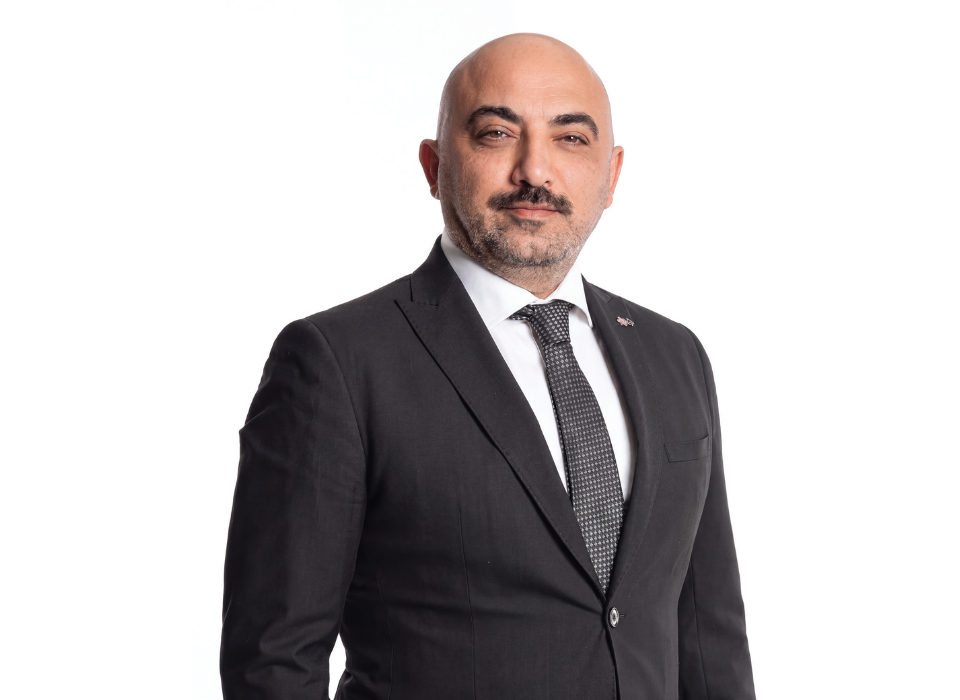
We Had an Enjoyable Conversation with Ruşit Ümit, General Manager of Politan Poliüretan.
Politan Poliüretan General Manager Ruşit Ümit answered our questions about the final products and product groups they manufacture using polyurethane materials, and their target sectors.
Ruşit Ümit, General Director of Politan Polyurethane, answered our questions about the final products and product groups they manufacture using polyurethane material, and their target sectors.
Could you briefly tell our readers about yourself, your education, and your professional background in the industry?
After completing my secondary and high school education at Kadıköy Anadolu High School, I graduated from the Chemical Engineering Department at Istanbul Technical University in 1995. I later completed a Master's degree (MBA) in Business Administration at the University of Pittsburgh in the United States. Since 1998, I have worked at Politan first as Commercial Manager, then as Production Manager, and now as General Director. Our company was founded in 1986 in a 100-square-meter shop in the Topçular district of Istanbul. In 1992, we relocated from Topçular to our own building in Hadımköy. We currently operate over 3,000 square meters of enclosed space. Here we have sandblasting, casting machines, furnaces, turning and grinding finishing departments, a toolroom, and a laboratory.What are the final products and product groups you manufacture using polyurethane material? Can you describe your product characteristics?
We have a very wide product range. Wheel coatings, sieves, die springs, plates, roller coatings, vibration screen coatings, oil and natural gas pipeline pigging scrapers, anvils for corrugated cardboard machinery, and couplings are among our main products. In our facility, we produce parts ranging from very small 3-5 gram pieces to pieces weighing over 1 ton. The main characteristics sought in the products we produce are resistance to wear, impact, and dynamic fatigue across a very wide range of hardness levels, as well as the flexibility inherent to elastomers. Sometimes the products are required to maintain these properties in different chemical environments. With such a wide product range and varying working conditions, it is not possible to achieve this with a single type of polyurethane raw material. For this reason, we use many different raw material groups. In fact, I can say that there is no other polyurethane casting company in Turkey that offers as much raw material diversity as we do.Which sectors demand your final products?
The products I mentioned earlier are in demand from the mining, glass, packaging, metal processing, textile, oil and natural gas, road maintenance, marble, construction machinery, and automotive sectors. Recently, we have been producing protective covers for cables that transmit energy from land-based wind turbines installed offshore to shore.Can you provide information about your laboratory and R&D activities? How do you use polyurethane material in your product, through which processes, and for what purposes?
To obtain the final product, we use prepolymers. As is known, to obtain polyurethane, a polyol and an isocyanate are needed. Companies like ours that produce prepolymers generally use two main groups of isocyanates: TDI-based or MDI-based. On the other hand, depending on the polyol you will use, TDI polyether and TDI polyester or MDI polyether and MDI polyester elastomer prepolymers are obtained. Each of these has different property combinations. To realize this wide product range that I mentioned, we use all four of these groups. In addition, we can also use other systems: such as NDI and Caprolactam. We are a company that produces polyurethane elastomer parts through casting. Therefore, to produce the desired part, we necessarily need a mold. We typically design and produce our molds in-house. Once an appropriate mold is obtained, depending on the product we want to produce, 2 or 3 main raw materials plus various additives are brought to appropriate temperatures. The mold to be used must also be brought to the temperature appropriate for the formulation. Then the mixture is prepared and poured into the mold. To prevent air voids in the final product, all mixtures are vacuumed before casting. After appropriate molding times, the parts are removed from the mold and heat treatment is applied to the parts. Finally, the finished products undergo finishing operations (deburring, cutting, grinding, etc.). Since 2007, our company has held ISO 9001 quality certification. In our laboratory, we conduct analytical and mechanical tests to control the properties of the raw materials used in production and the formulations we apply. At the same time, upon request from our customers, we modify the chemistry of raw materials in our laboratory to make improvements targeted at certain properties. In this way, we make raw materials developed for more general applications more suitable for specific applications. We have R&D studies related to these matters. We successfully completed a research project with TEYDEB, and we are currently preparing work on a Eureka project with a foreign company.What advantages, quality, and value does polyurethane material add to your final product?
The polyurethane systems we work with are thermoset elastomers and possess all the properties of an elastomer. Therefore, they demonstrate superior performance compared to conventional rubbers in many applications. A product made from polyurethane elastomer with the properties I mentioned has a much longer lifespan than plastic, rubber, or even metal products. Polyurethane elastomer also has a technological advantage. To shape rubber and plastic, temperature and pressure are required at the same time. Since the raw material in polyurethane is liquid, you can cast it even in open (very simple) molds. Additionally, you can shape it mechanically (turning, milling). This characteristic makes polyurethane economically suitable even for very small quantities.Among your targets and projects, is there a new final product to be created using polyurethane material?
We are a customer-focused company. About 99% of our products are manufactured to order. For this reason, it may not be described as a new final product, but rather we have projects more along the lines of creating new product groups. One of these is developing products for the food industry using FDA-approved and similar organizations' raw material groups that are 100% suitable for food contact. Another project of ours is developing high-temperature resistant products. Our current products withstand 80°C. We have ongoing work on products that withstand higher temperatures.What is the most interesting final product manufactured using polyurethane material, in your opinion?
In 2008, we jointly developed a component with a Dutch company. It was a type of guide component that would be used for laying cables that transmit electricity generated by offshore wind generators to shore. It was a product created by combining 5 different polyurethane parts, each 6 meters in total length, of different hardness levels and composed of different raw material groups. It was designed to enable 130 mm-thick cables to be mounted smoothly by a fully remote-controlled robot at 45 meters below sea level.Gallery




Advertisement
Ad Space728 × 90