Sabancı University IICEC Brought Water Security and Sustainability to the Agenda at COP31
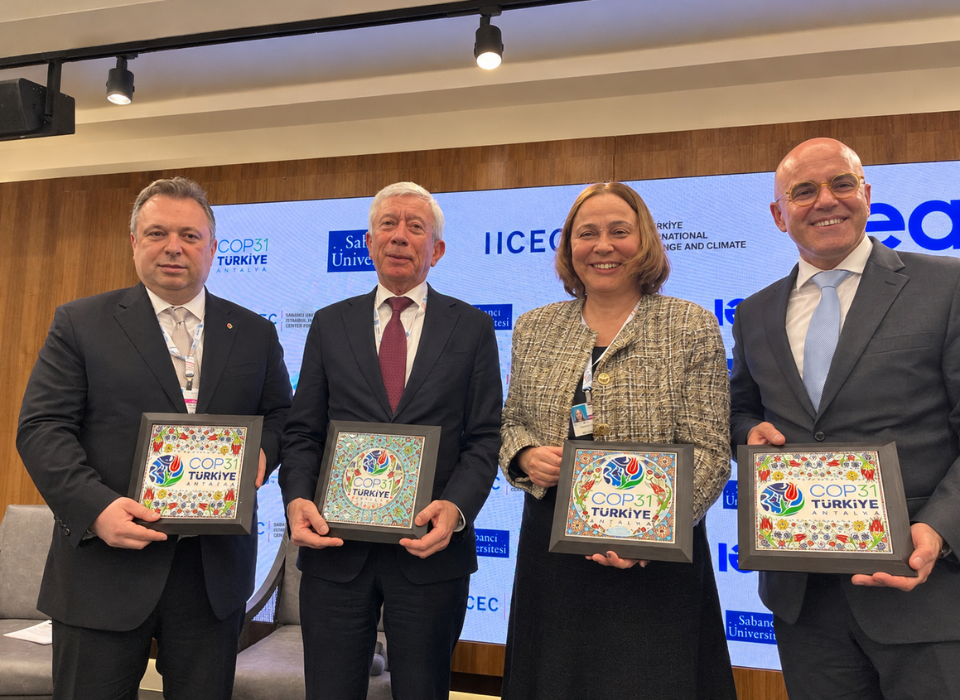
Sabancı University Istanbul International Center for Energy and Climate (IICEC) addressed growing water stress, risks to water security, and solution proposals at the Special Water Event it organized in Antalya within the scope of COP31. At the event, which opened with a speech by International Energy Agency (IEA) Executive Director and IICEC Honorary Chairman Dr. Fatih Birol, the IICEC COP31 Special Water Report was introduced. In the panel attended by senior representatives of the business world, water security and sustainability were evaluated within the framework of resource efficiency, technological solutions, investments, and their relationship with electrification.
The event organized by Sabancı University IICEC was held on November 9, 2026 at the Antalya Expo Blue Zone Türkiye Pavilion. Energy Efficiency Association President Ahmet Erdem, SOCAR Türkiye CEO and Advisor to the SOCAR President Elchin Ibadov, and Hitachi Energy Türkiye General Manager Yasemin Öztekin participated as speakers in the panel moderated by Sabancı Holding CEO Kıvanç Zaimler.
Dr. Fatih Birol: "The water issue is extremely important and strategic"
Speaking at the opening of the event, International Energy Agency Executive Director and IICEC Honorary Chairman Dr. Fatih Birol drew attention to the critical importance of water stress for the energy sector. Birol stated that he considered it important for IICEC to bring the water issue to the agenda and to prepare a special report in this field, and expressed that he eagerly awaited the findings and recommendations that the study would reveal.
Sharing the example of Hungary regarding how declining water resources can directly affect energy supply security, Birol noted that the significant drop in river water levels due to extreme heat and drought made it difficult to meet the cooling needs of nuclear power plants and led to plants being taken offline. Birol emphasized that this example demonstrated the strong relationship between water security and energy supply security.
Dr. Fatih Birol: "The success of COP31 will be measured by concrete decisions"
Stating that the success of COP31 should be evaluated not only by high-level participation but also by the concrete decisions to be taken at the end of the summit, Birol shared his proposal that electrification should be one of the conference's main outcomes.
Noting that electricity's share in total energy consumption today stands at approximately 23 percent, Birol stated that they propose raising this ratio to 35 percent by 2035. Stating that he hopes more than 100 governments will make commitments within the scope of the target called "35 by 35," Birol said that such a decision would send a strong message to energy markets and investors about the future role of electrification.
Kıvanç Zaimler: "The IICEC Special Water Report will guide Türkiye's sustainable water future"
Sabancı Holding CEO Kıvanç Zaimler drew attention to the fact that increasing water stress in Türkiye could have critical consequences for industry, the energy sector, and other economic activities.
Stating that the relationship between electrification targets and water management needs to be addressed more closely in the coming period, Zaimler emphasized the importance of disseminating effective and efficient solutions against water stress across all sectors. Noting that IICEC contributes to the determination of strategies and directions through its pioneering and analytical reports for the energy sector, Zaimler stated that the Special Water Report would also be a guide for Türkiye's safer and more sustainable water future.
Ahmet Erdem: "Efficiency is a common solution area in water and energy"
Energy Efficiency Association President Ahmet Erdem, in his assessment of Türkiye's water resources, noted that approximately half of the average annual gross freshwater budget of 450 billion cubic meters is lost to evaporation, and that half of the remaining amount constitutes the technically and economically usable net potential.
Stating that freshwater consumption has increased approximately 1.5 times over the last 20 years to exceed 60 billion cubic meters, Erdem drew attention to the fact that climate change is increasing pressure on limited water resources. Stating that the balance between water supply and consumption constitutes an increasingly important risk area for Türkiye, Erdem said this situation could create effects across a wide area, from agriculture to industry and from energy to households.
Noting that seasonal effects are observed together in water and electricity supply and consumption, Erdem emphasized that efficiency in both areas carries common solution potential. Stating that reducing water losses would also contribute to energy efficiency, Erdem pointed to the importance of investment and governance processes for a secure and sustainable water future.
Elchin Ibadov: "The future of water and energy systems lies in integrated solutions"
SOCAR Türkiye CEO and Advisor to the SOCAR President Elchin Ibadov evaluated the impact of water crises on societies and economies through the example of the drought during the Hittite Empire period. With the words "The Hittites could sit at the table with Egypt, but they could not sit at the table with the rain," he emphasized the importance of foreseeing water risks in advance and taking timely precautions.
Stating that measuring the water footprint in industry, reusing water, and addressing water management not only at the facility scale but also at the basin scale is necessary, Ibadov shared the "blue energy combined cycle" approach, which brings together wind energy, seawater treatment, data centers, and the chemical industry.
Within the scope of this model, it is envisaged that seawater will be treated using wind energy, the salt and minerals obtained as a result of treatment will be utilized in the chemical industry, the treated water will be used for liquid cooling in data centers, and the waste heat released from data centers will be reused in chemical production processes.
Ibadov stated that, in addition to planning water and electricity together, university-industry cooperation is also critically important in developing such integrated solutions.
Yasemin Öztekin: "Water efficiency, digitalization, and integrated planning should be priorities"
Hitachi Energy Türkiye General Manager Yasemin Öztekin stated that water scarcity is not merely an environmental problem; it is a critical issue that also affects economic, social, and infrastructure resilience.
Drawing attention to the fact that the interdependence between water and electricity systems will increase as electrification accelerates, Öztekin said that these two systems need to be planned in an integrated manner and that resources need to be used more efficiently through digital infrastructures.
Stating that the focus in water management should shift toward water efficiency in addition to resource management, Öztekin listed reducing water losses in urban networks, expanding precision irrigation systems in agriculture, rainwater harvesting, and increasing the reuse of treated water as priority solution areas.
Stating that digital monitoring, forecasting, and smart grid applications used in the electricity sector also offer opportunities for water infrastructures, Öztekin emphasized that predictable regulatory frameworks and new financing models that make projects financially viable are needed for the widespread adoption of water efficiency investments.
The IICEC COP31 Special Water Report addresses Türkiye's water risks in a holistic manner
At the event, IICEC Director Bora Şekip Güray gave the introductory presentation of the IICEC COP31 Special Water Report. Stating that Türkiye is already under water stress and that some basins are experiencing water scarcity, Güray noted that increasing water stress constitutes a strategic and growing risk area for the country.
Within the scope of the report, Türkiye's freshwater resources and consumption dynamics, as well as risks, opportunities, and solution areas related to water stress, water security, and sustainability, are being evaluated with an analytical approach. The study, developed with a "success triangle" model based on cooperation between the public sector, industry, and academia, aims to provide concrete recommendations for Türkiye's safer and more sustainable water future.
Güray stated that the report also specifically examines the bidirectional dynamics between the water and electricity sectors in connection with COP31's electrification agenda.
"Every link of the energy transition depends on water"
Sabancı University IICEC Coordinator Dr. Mehmet Doğan Üçok, who moderated the event, stated that water plays a determining role at every stage of the energy transition.
Üçok made the following statements in his assessment:
"COP31 is defined as an implementation summit; as Sabancı University IICEC, we are responding to this call from the area where climate change is felt first and most directly, namely water. Water is not a side issue of the energy transition; it is present at every stage of the transformation. Every link of the energy transition, from electricity generation to hydrogen, from critical minerals to cooling, depends on water; increasing water stress on a global scale is putting these links under growing strain. With the IICEC COP31 Special Water Report, we present the current situation and future outlook with Türkiye's own data and applicable policy options, and we are bringing this issue to the world's agenda in Antalya. The solution proposals shared by senior business world representatives in the panel also showed that concrete steps can be taken in this area. This event is a contribution by IICEC to closing the gap between commitments and implementation. The concept of 'Implementation COP' is therefore extremely important."
Advertisement
Ad Space728 × 90