Technical Foam Trends in the Mattress Sector: From Comfort Engineering to Circularity
Summary
Mattress engineering is moving beyond the simple question of whether a foam feels soft or firm. Technical foam layers are increasingly designed as a coordinated system in which pressure distribution, resilience, thermal and moisture comfort, emissions, durability, transport efficiency and end-of-life strategy are considered together. Flexible polyurethane foam remains a central platform because density, cell structure, hardness, recovery and damping can be tuned over a broad design window [1].
The strongest trend is therefore not a single “new foam”, but multifunctional layer engineering. High-resilience support foams, viscoelastic comfort layers, open-cell or reticulated structures, gel or phase-change assisted thermal layers and recycled-content solutions are being combined according to the function of each zone. At the same time, low-VOC requirements and third-party certification are becoming routine quality expectations in bedding markets [4].
Circularity is becoming equally important. European mattress collection and recycling systems are expanding, chemical recycling routes for polyurethane mattress foam are being industrialised, and the EU Ecodesign for Sustainable Products Regulation creates a framework for product information and Digital Product Passports [2,5,7]. For foam and mattress producers, this means that future competitiveness will depend on measurable comfort and durability together with traceable chemistry and recycling-ready design.
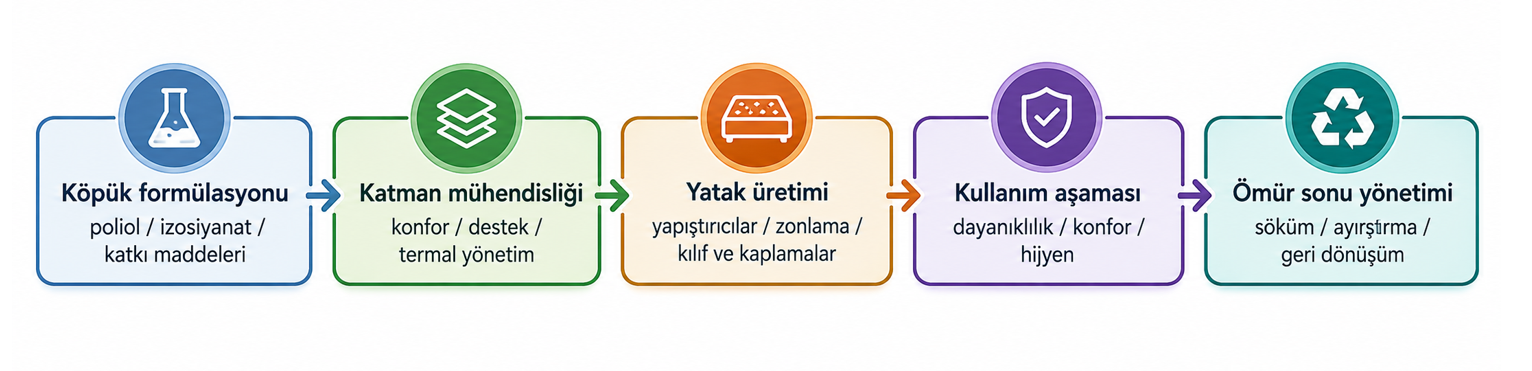
Figure 1. Engineering logic for next-generation technical foam systems in mattresses.
1. Technical foam is becoming a layered performance system
Modern mattress design assigns a distinct task to each layer. A high-resilience (HR) support core must provide load bearing and elastic recovery; a viscoelastic comfort layer is used to redistribute contact pressure and damp movement; more open cell structures can improve air exchange; and speciality additives or inserts can modify heat storage and perceived surface temperature. This layered approach allows the manufacturer to avoid over-specifying every layer for every function.
The critical engineering parameter is no longer density alone. Density is useful for material control, but it must be interpreted together with indentation force deflection/load deflection, hysteresis, resilience, compression set, fatigue loss, airflow and recovery behaviour. A “premium” foam should therefore be described by a performance envelope, not by one marketing number.
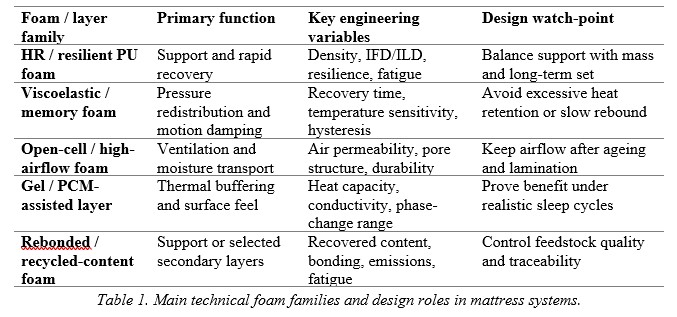
Thermal comfort must be considered specifically since there may be a misunderstanding about “cooling.” The foam does not produce cooling energy; rather, it changes the transfer of transient heat and moisture. An open cell can make the convective exchange better, while gel or phase change materials can temporarily store the heat. This is the engineering challenge of how long the effect lasts, whether it is recovered from sleep to sleep, and whether it affects fatigue resistance, emissions, or recycling.
For producers, zoning is another important trend. Instead of increasing overall foam mass, local geometry, perforation, contour cutting and differentiated firmness can place material where mechanical support is required. This is a material-efficiency strategy as much as a comfort strategy: the target is more function per kilogram of foam.
2. From comfort claims to measurable engineering KPIs
A technically strong mattress programme should connect consumer language to testable parameters. “Support” should be linked to load-deflection behaviour and durability; “pressure relief” to pressure mapping and hysteresis; “breathability” to airflow and water-vapour management; and “clean indoor air” to controlled chemical composition and emissions. CertiPUR™ in Europe is one example of a voluntary programme that limits certain substances and requires low VOC emissions for polyurethane foams used in bedding and upholstered furniture [4].
Durability is also a sustainability metric. A foam that retains its mechanical response over repeated loading avoids premature replacement and distributes its production impact over a longer service life. For that reason, fatigue loss, compression set, dimensional stability and bond integrity between layers should be reported together with initial comfort data.
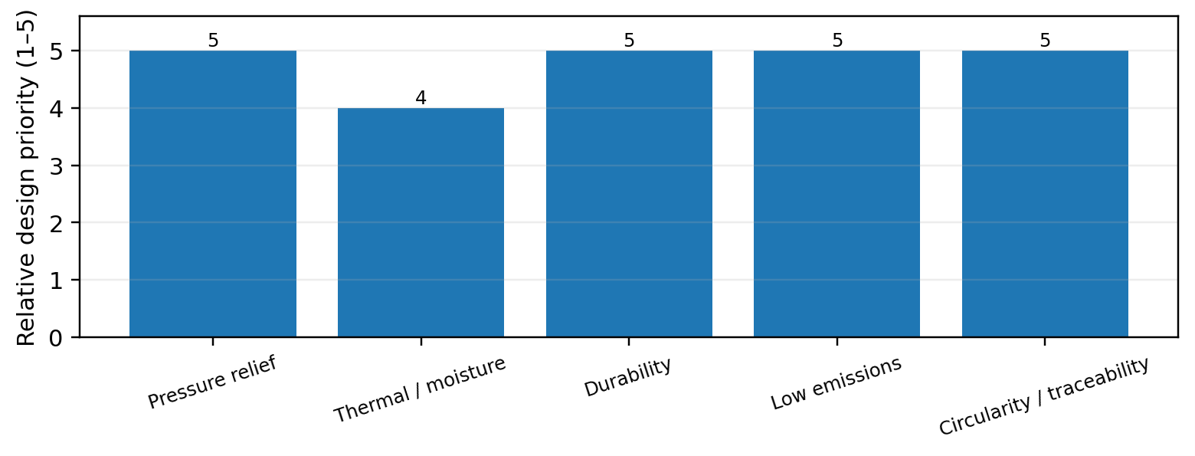
Figure 2. Relative design priorities for technical mattress foams (editorial engineering synthesis, not market-share data).
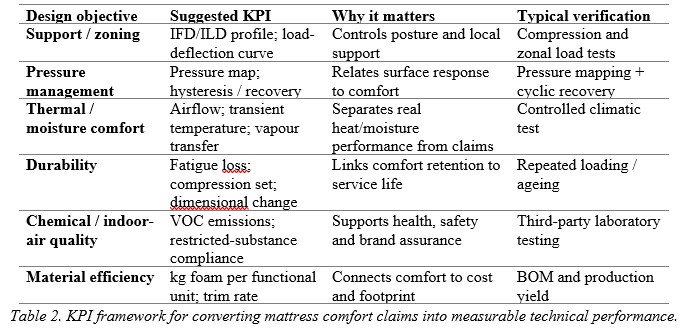
The practical implication is simple: formulation teams, foamers and mattress assemblers should share one qualification matrix. A material change that improves thermal feel but increases VOC emissions, lowers fatigue life or blocks recycling may not be a system-level improvement. Multi-criteria qualification avoids this problem.
3. Circularity, low-carbon feedstocks and digital traceability
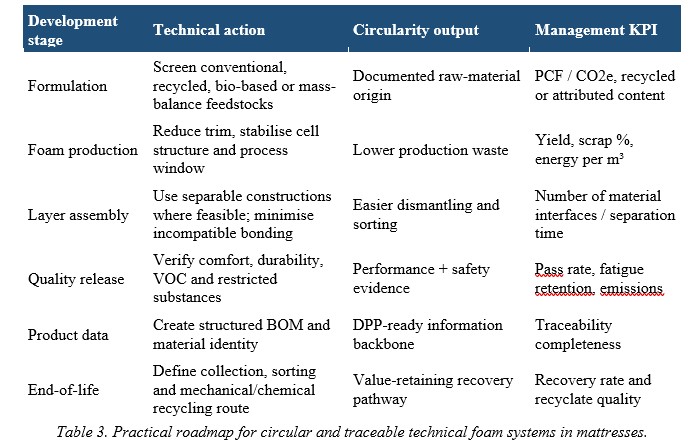
The mattress sector is becoming one of the most visible circular-economy applications for flexible PU foam because mattresses can be collected, dismantled and sorted at relatively high material concentration. EUROPUR reports that around 40 million mattresses reach end-of-life in Europe each year, while EPR and national collection schemes are expanding in several countries [2,3]. Mechanical recycling into bonded foam remains important, and a dedicated CertiPUR™ module for bonded foam was launched in 2025 [8].
The next step is feedstock circularity. Recycled polyols, bio-based polyols and mass-balance approaches are moving from pilot concepts into commercial product portfolios. BASF announced biomass-balance polyether polyols for sleep products in 2026, using certified traceability while maintaining conventional material performance [6]. Chemical recycling approaches are also progressing: Covestro’s Evocycle® CQ Mattress concept targets recovery of the two main raw-material building blocks from end-of-life PU mattress foam [7].
Regulation will increasingly reinforce traceability. The regulation (EU) 2024/1781 sets out the ESPR and Digital Product Passport systems. Specific obligations for products will be laid down by means of delegated acts. Consequently, manufacturers cannot assume that all is already required; however, there is a definite trend towards increasing structure and machine readability regarding product composition, durability, materials of concern, repair/reuse information and end-of-life [5].
Conclusion
Technical foam innovation in mattresses is shifting from “new sensation” marketing toward verified multifunctional performance. The successful approaches will balance pressure regulation, resilience, thermal and moisture management, reduced emissions, durability and circularity without material overconsumption. This is why the task for the foam manufacturer is to create an envelope for performance; and the task for the mattress maker is to integrate the layer architecture with material traceability and a credible disposal process. Thus, the future mattress is not just softer, harder or cooler. It is engineered and designed to have value after its useful life.
Selected references
[1] EUROPUR, “Understanding Flexible Polyurethane Foam: Properties and Benefits for Mattresses,” 13 February 2025.
[2] EUROPUR, “Recycling Initiatives for Mattresses in Europe: EPR Schemes and National Approaches,” 14 July 2025.
[3] EUROPUR, “Sustainability” and “Resource Efficiency & Recycling,” flexible polyurethane foam information resources.
[4] EUROPUR, CertiPUR™ programme for polyurethane foam used in bedding and upholstered furniture.
[5] European Union, Regulation (EU) 2024/1781 establishing the Ecodesign for Sustainable Products framework and Digital Product Passport.
[6] BASF, “Biomass balance polyether polyol product portfolio for the sleep products, automotive and CASE industries,” 10 March 2026.
[7] Covestro, Evocycle® CQ Mattress / chemical recycling of end-of-life polyurethane mattress foam.
[8] EUROPUR, “CertiPUR™ for Bonded Foam,” 5 December 2025.
Galeri