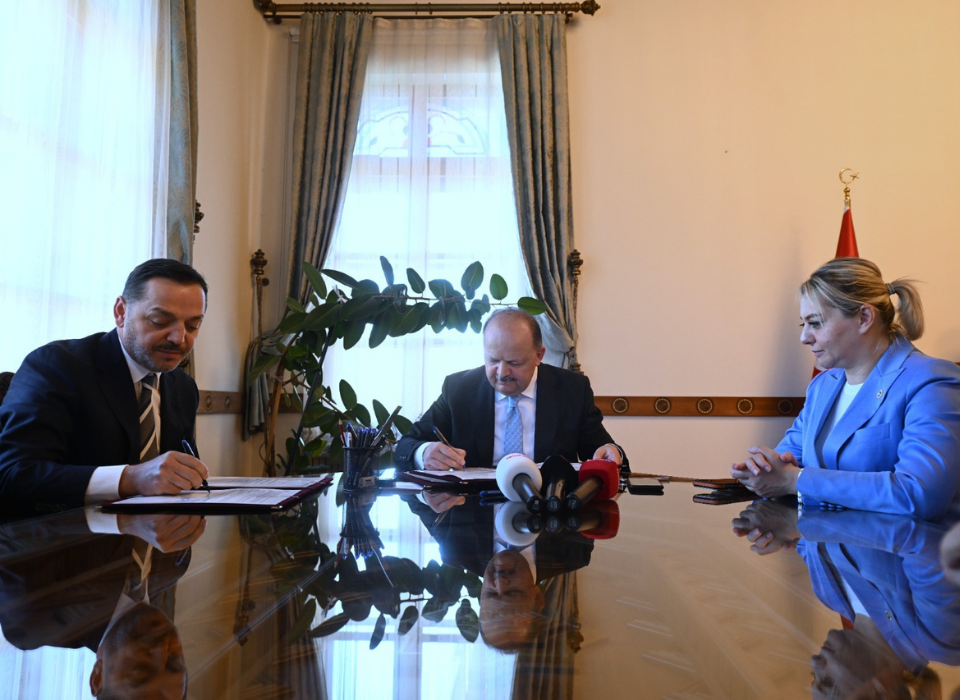
TÜBİTAK Support for Bonna's R&D Project Focused on Green Transformation

Bonna has become eligible to receive support under the TÜBİTAK 1832 Green Transformation in Industry 2025-3 Call with its project titled "Next-Generation Tableware Production Technology with High Waste Content, Sintered at Low Temperature," which aims to enable the reuse of waste in porcelain production and increase energy efficiency. Within the scope of the project, the development of next-generation porcelains containing a high proportion of recycled waste and capable of being sintered at lower temperatures is targeted.
Bonna has become eligible to receive support under the TÜBİTAK 1832 Green Transformation in Industry 2025-3 Call with its project titled “Next-Generation Tableware Production Technology with High Waste Content, Sintered at Low Temperature,” which aims to enable the reuse of waste in porcelain production and increase energy efficiency. Within the scope of the project, the development of next-generation porcelains containing a high proportion of recycled waste and capable of being sintered at lower temperatures is targeted.
Bonna, which develops porcelain and tabletop solutions for the HoReCa sector, has added a new project to its R&D efforts in the field of sustainable production. The project, prepared under the leadership of the Bonna Sustainability Committee, has become eligible for support under the TÜBİTAK 1832 Green Transformation in Industry 2025-3 Call.
The project, titled “Next-Generation Tableware Production Technology with High Waste Content, Sintered at Low Temperature,” aims to bring not only the waste generated during porcelain production processes but also porcelain products that have reached the end of their service life back into the production cycle.
Goal: Higher recycled content, lower energy consumption
Among the main objectives of the project are reducing the amount of raw materials and natural resources used in production, reusing porcelain waste, and lowering energy consumption.
In this context, Bonna aims to develop next-generation porcelain formulations and production technologies containing a high proportion of recycled waste. Developing production processes that will provide lower energy consumption by optimizing firing temperature and duration will also be one of the important areas of study in the project.
With the implementation of the technology to be developed, it is envisaged that resource efficiency in production processes will be increased, energy consumption will be reduced, and a contribution will be made to lowering the carbon footprint. In addition, by reusing the waste generated from porcelain production as raw material, it is aimed to integrate the circular economy approach into production processes more effectively.
Sustainability and R&D advance together
Bonna's sustainability efforts are carried out with a long-term transformation approach that encompasses waste management, energy efficiency, and the development of production technologies. The company addresses its R&D and innovation efforts together with resource efficiency, circular economy, and low-carbon production goals.
The project, which has become eligible for TÜBİTAK support, stands out as an important step in this approach. With the next-generation production technologies targeted to be obtained as a result of the project, it is aimed to develop production models with lower raw material and natural resource use, lower energy consumption, and less environmental impact.
“We are advancing sustainable production with our R&D and innovation strength”
Bonna General Manager Erbil Aşkan stated that the TÜBİTAK support is an important step in terms of the company's sustainability and R&D vision.
Aşkan used the following statements in his assessment on the subject:
“We view sustainability not merely as an environmental responsibility, but as one of the fundamental elements of our future-oriented business model. Our project, which we developed under the leadership of the Bonna Sustainability Committee and which has become eligible for support under the TÜBİTAK 1832 Green Transformation in Industry Program, is an important indicator of our goal of transforming this approach into a concrete production technology through our R&D and innovation strength.
While bringing waste generated during porcelain production processes and porcelain products that have completed their service life back into the production cycle, we aim to reduce the use of natural resources and raw materials, increase our energy efficiency, and lower our carbon footprint. Developing next-generation porcelain technologies that contain a high proportion of recycled waste and provide energy-efficient production by optimizing firing temperature and duration is an important step not only in terms of transforming our production processes, but also in terms of the widespread adoption of more sustainable production models in our sector.
As Bonna, by bringing together our R&D competence with our sustainability goals, we are focusing on developing production technologies that use resources more efficiently, support the circular economy, and have a lower environmental impact. In line with our ‘Let it remain for tomorrow too’ philosophy, we will continue to work for a more sustainable future in every step we take, from production to social contribution.”
About Bonna
Bonna, launched in 2014 as the HoReCa brand of Kar Porselen, which began its operations as a small ceramics workshop in İstanbul in 1983, develops innovative tabletop solutions for the hotel, restaurant, and catering sector.
Bonna currently exports products to more than 110 countries across 6 continents, while also offering customized products and solutions for the different needs of the professional food and beverage sector. Increasing its production capacity with new factory investments abroad in addition to its production facilities in Türkiye, Bonna holds the position of export champion of Türkiye in its category.
Bonna, which has also received awards in national and international design competitions through collection works carried out with domestic and foreign designers, has been deemed worthy of various awards at organizations such as REDDOT DESIGN AWARD, GERMAN DESIGN AWARD, AI DESIGN AWARD, IDA DESIGN AWARDS, DNA PARIS AWARD, and DESIGN TURKEY.
Gallery