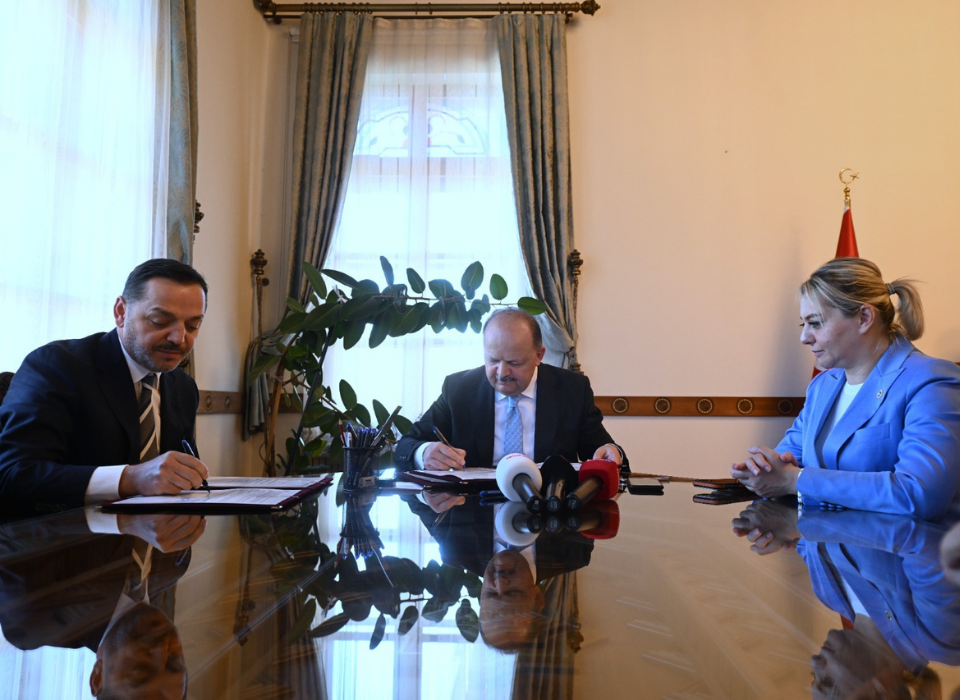
TÜGİS Launches EU- and UN-Supported "No to Child Labor" Project

The Turkish Food Industry Employers' Union (TÜGİS) and the Working Life Association have launched a project aimed at preventing child labor, one of Türkiye's major social issues. The "Big Futures for Small Hands: No to Child Labor" project aims to raise awareness for effective action against child labor.
Turkey's Food Industry Employers Association (TUGIS) and Working Life Association have launched a project to prevent child labour, one of Turkey's major social issues. Under the "Big Futures for Small Hands: No to Child Labour" project, the aim is to raise awareness for effective action against child labour.
In line with the project launched with support from the European Union Delegation to Turkey and grant support provided by the International Labour Organization (ILO), a United Nations agency, various training and information programmes will be organised for all sector stakeholders over a 1-year period.
TUGIS, the representative of new-generation unionism in our country, continues its pioneering role in corporate social responsibility areas alongside activities aimed at increasing the competitiveness of its members. Within this scope, TUGIS and Working Life Association, which are part of the "Strengthening the Capacity of Social Partners and Civil Society Organisations on Fundamental Principles and Rights at Work Project" financed by the European Union and conducted by the International Labour Organization (ILO), have launched the "Big Futures for Small Hands: No to Child Labour" project. The project aims to inform TUGIS members and all stakeholders within the food ecosystem in accordance with international legislation on child labour prevention, in line with ILO policies.
Agriculture, industry and service sectors lead the way
In his assessment of the project, TUGIS Board Chairman Kaan Sidar emphasised that child labour continues to be a significant problem in Turkey both economically and socially. Defining child labour as employing individuals under 18 years of age in jobs that could negatively affect their physical, mental, social and moral development, Sidar noted that the causes of this situation could include poverty, lack of access to education, refugee situations, family pressure and traditional roles.
Turkey has 720,000 child workers aged 5-17
Noting that according to statistics the number of child workers in the 5-7 age group in Turkey is around 720,000, Kaan Sidar stated, "Agriculture, industry and service sectors are the areas where child labour is most prevalent. According to reports by the International Labour Organization (ILO) and UNICEF, 30.8% of working children in our country are in agriculture, 23.7% in industry and 45.5% in the service sector. Marginal jobs such as street vending also fall into this category. While 79.7% of working children are in the 15-17 age group, 15.9% are in the 12-14 age group and 4.4% are in the 5-11 age group."
Sidar added, "When child labour is examined by gender, 70.6% of working children are boys and 29.4% are girls. In short, this cycle that begins with child labour becomes a vicious cycle that deprives the child of development opportunities. This brings with it problems such as loss of education, health problems, developmental harm and risk of exploitation."
"We will contribute to raising awareness against child labour"
Addressing child labour also from a legal perspective, Kaan Sidar stated, "In Turkey, the Labour Law No. 4857 prohibits employing children under 15 years of age, with some exceptions. Our country has become a party to the International Convention on the Rights of the Child. The Ministry of Family and Social Services also implements various action plans in cooperation with the ILO. As TUGIS, we will bring together all sector stakeholders through the project we will conduct with Working Life Association for 1 year, organising trainings and information programmes. We will also contribute to raising public awareness through various printed materials and announcements on social media."
One in every 13 children in the world works!
According to data from the International Labour Organization (ILO) and UNICEF, 138 million children worldwide—in other words, one in every 12 children—are currently working as child labourers. Approximately half of these children work in hazardous jobs that affect their health and development (around 40%), with numbers reaching 54 million.
Looking at the distribution of child labour by region; Africa has the highest figures both in percentage and absolute numbers in child labour, with 86.6 million children and a rate of 21.5%. In second place is the Asia-Pacific region in absolute numbers: with a rate of 3.1%, 27.7 million children. In percentage terms, the Latin America and Caribbean region comes in second place with 5.5%. The remaining child worker population is distributed among other regions.
Gallery