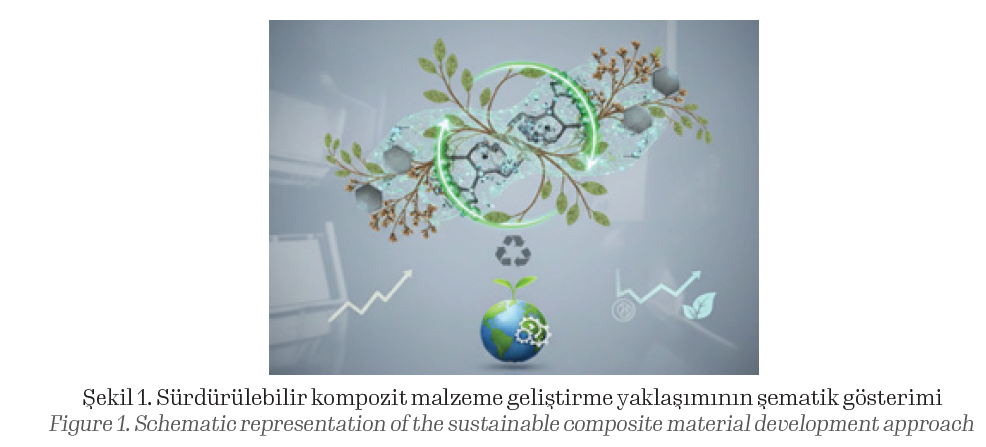
Today, composite material technologies focus not only on enhancing mechanical performance but also on criteria such as environmental sustainability, efficient use of natural resources and recyclability. In this context, modifying fossil-based polymers with natural and inorganic fillers constitutes an important research area, both in terms of reducing the environmental footprint and improving functional properties.
1. Introduction
Today, composite material technologies focus not only on improving mechanical performance but also on criteria such as environmental sustainability, efficient use of natural resources, and recyclability [1]. In this context, modifying fossil-based polymers with natural and inorganic fillers constitutes an important research area in terms of both reducing environmental footprint and improving functional properties [2].
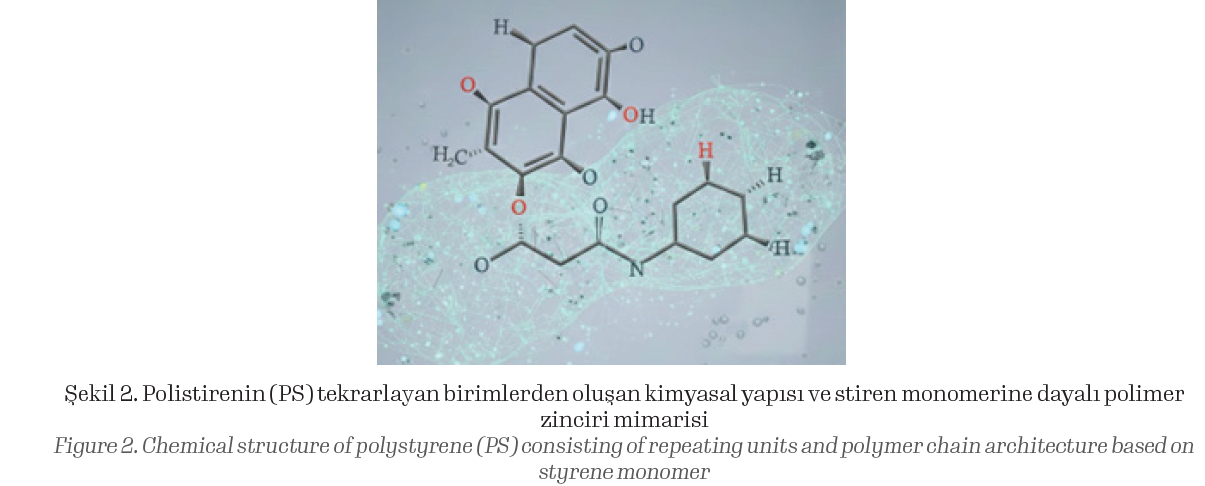
Polystyrene (PS) is a widely used thermoplastic due to its low density, good flowability, dimensional stability, and suitability for industrial production methods such as injection molding and extrusion [3]. General-purpose polystyrene (GPPS) in particular is preferred in decorative and structural applications thanks to its rigid structure and surface quality. However, PS's relatively low impact resistance and lack of natural aesthetics limit its use in wood-like applications [4].
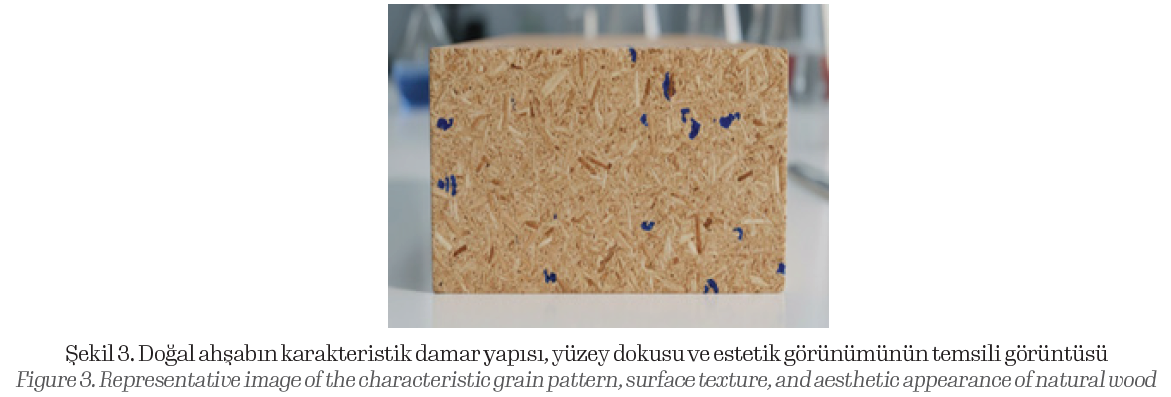
Wood flour is widely used as a filler material in polymer composites as a renewable, biodegradable, and low-cost option. In addition to imparting a natural appearance and texture to the polymer matrix, it provides significant advantages in terms of sustainability [5]. However, the hydrophilic nature of wood flour can create negative effects such as water absorption, dimensional instability, and reduction in mechanical properties. For this reason, wood-based polymer composites require additional modifications that increase moisture resistance and improve interfacial compatibility [6].
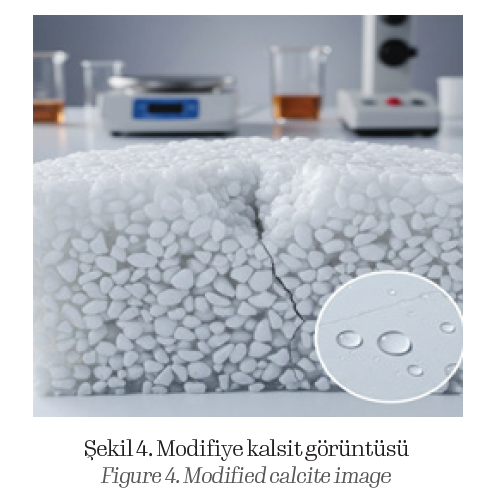
Calcite (CaCO₃) is an inorganic filler commonly used in polymer composites. Although traditionally evaluated as a cost-reducing additive, when used with appropriate particle size and surface modification, it can provide significant improvements in mechanical strength, stiffness, and thermal stability [7]. In particular, calcite surface-modified with hydrophobic agents such as stearic acid strengthens the interfacial bond between the polymer matrix and the filler, and increases the composite's resistance to water [8].
The aim of this study is to develop a next-generation composite material containing a GPPS matrix, natural wood flour, and water-repellent modified calcite, featuring wood appearance, light weight, high mechanical performance, and high moisture resistance. Additionally, it is intended to impart a realistic wood texture to the composite through a unique surface texturing and varnishing method.
2. Materials and Methods
2.1. Materials
General-purpose polystyrene (GPPS) was used as the main matrix of the composite. Oak wood flour with a particle size of 80–120 mesh, dried and ground, was selected as the natural filler. As the inorganic filler and functional modifier, calcite (CaCO₃) with an average particle size of approximately 5 μm and surface-modified with a stearic acid-based agent was used. In surface coating procedures, a clear polyurethane-based varnish was applied.
2.2. Formulation and Mixing
Four different formulations were prepared to investigate the effects on mechanical and physical properties of the composites. The components were subjected to pre-mixing in a high-speed mechanical mixer to ensure homogeneous distribution.
2.3. Extrusion and Injection Molding
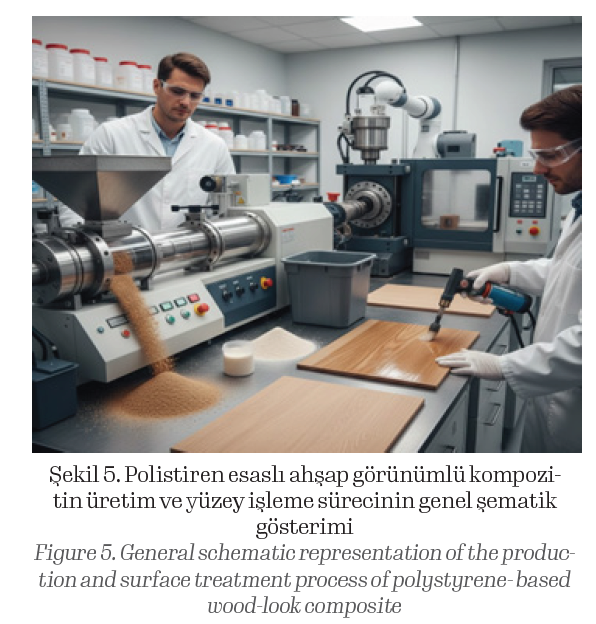
The prepared mixtures were homogenized in the melt phase using a twin-screw extruder and converted into pellets. The twin-screw extruder, through high shear force, ensures homogeneous distribution of fillers in the polymer matrix. The resulting pellets were converted into test specimens and panel forms compliant with ASTM standards using an injection molding machine.
2.4. Surface Texturing and Coating
The flat-surfaced panels from the mold were subjected to local surface melting using a controlled heat source (torch). This process created a surface morphology imitating the natural grain and pore structure of wood. After texturing, surfaces were sanded and a clear polyurethane varnish was applied.
2.5. Characterization
Density measurements, tensile (ASTM D638), flexural (ASTM D790), impact (ASTM D256), water absorption (ASTM D570), and surface coating adhesion tests (ASTM D3359) were performed.
3. Results and Discussion
3.1. Density and Mechanical Properties
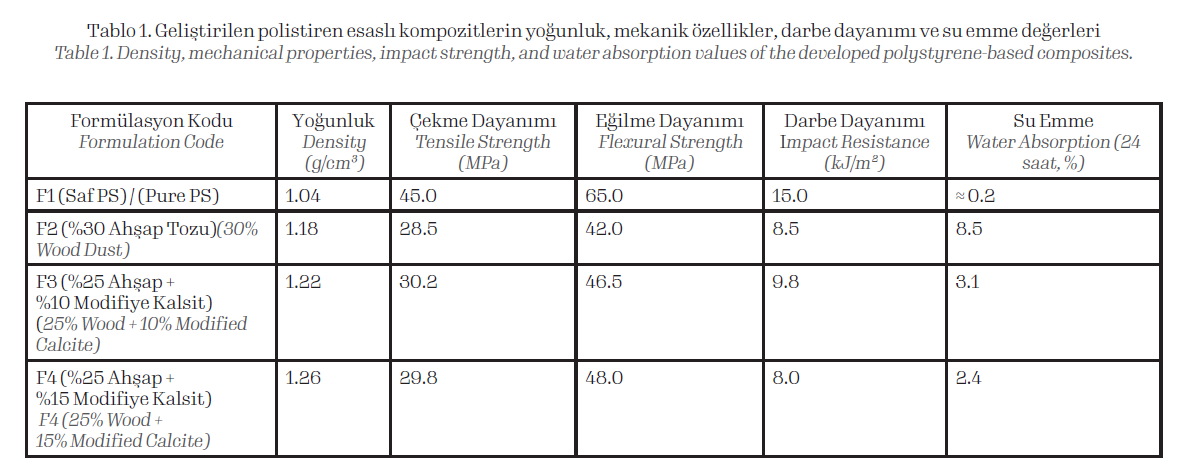
The neat polystyrene (F1) specimen exhibited a density of 1.04 g/cm³, while increases in density values were observed with the addition of wood flour and calcite. The F2 formulation containing 30% wood flour reached a density of 1.18 g/cm³. In the F3 and F4 formulations containing modified calcite, densities were measured at 1.22 and 1.26 g/cm³, respectively [9].
Tensile and flexural test results showed that wood flour addition reduced mechanical strength compared to neat PS, but modified calcite addition partially compensated for this loss [10]. The flexural strength in the F2 specimen was 42.0 MPa, while in the F3 specimen containing 10% modified calcite, this value increased to 46.5 MPa. This indicates that modified calcite distributes better within the polymer matrix, improving load transfer [11].
3.2. Impact Resistance
The highest impact resistance value was obtained in the neat PS specimen (15.0 kJ/m²). With the addition of wood flour, this value decreased to 8.5 kJ/m² in the F2 formulation. However, in the F3 formulation, impact resistance increased to 9.8 kJ/m². This increase indicates that the fine-grained and surface-modified calcite creates a mechanism that restricts crack propagation [12]. The high calcite ratio in the F4 formulation caused the material to become more rigid, and impact resistance decreased to 8.0 kJ/m².
3.3. Water Absorption and Dimensional Stability
Water absorption tests clearly demonstrated the critical role of modified calcite on the moisture resistance of the composite. After 24 hours of water immersion, the F2 specimen showed 8.5% water absorption, while in the F3 and F4 specimens, these values were measured at 3.1% and 2.4%, respectively. This significant reduction demonstrates that hydrophobic calcite particles block the hydrophilic nature of the wood flour, creating a barrier effect within the composite [13].
3.4. Surface Coating Performance
In the crosshatch (grid) test according to ASTM D3359 standard, a 5B adhesion rating was obtained on textured and varnished surfaces. This result demonstrates that the developed surface texturing and coating method creates excellent bonding with the composite surface [14].
4. Conclusion
In this study, a lightweight, high-performance, and aesthetically superior polystyrene-based composite was successfully developed using natural wood flour and water-repellent modified calcite, eliminating the disadvantages of conventional wood. In particular, the F3 formulation containing 25% wood flour and 10% modified calcite stood out as the optimum composition in terms of mechanical strength, impact resistance, low water absorption, and cost balance. The developed composite presents high potential for interior and exterior furniture, decorative coatings, automotive interior trim parts, and sustainable building applications.
References
[1] Krauklis, A. E., Karl, C. W., Gagani, A. I., & Jørgensen, J. K. (2021). Composite material recycling technology—state-of-the-art and sustainable development for the 2020s. Journal of Composites Science, 5(1), 28.
[2] Luzi, F., Torre, L., Kenny, J. M., & Puglia, D. (2019). Bio-and fossil-based polymeric blends and nanocomposites for packaging: Structure–property relationship. Materials, 12(3), 471.
[3] Ghoshal, T., Parmar, P. R., Bhuyan, T., & Bandyopadhyay, D. (2023). Polystyrene foams: Materials, technology, and applications. In Polymeric Foams: Fundamentals and Types of Foams (Volume 1) (pp. 121-141). American Chemical Society.
[4] Chanhoun, M., Padonou, S., Adjovi, E. C., Olodo, E., & Doko, V. (2018). Study of the implementation of waste wood, plastics and polystyrenes for various applications in the building industry. Construction and Building Materials, 167, 936-941.
[5] Cabrera, F. C. (2021). Eco-friendly polymer composites: A review of suitable methods for waste management. Polymer Composites, 42(6), 2653-2677.
[6] Ramesh, M., Rajeshkumar, L., Sasikala, G., Balaji, D., Saravanakumar, A., Bhuvaneswari, V., & Bhoopathi, R. (2022). A critical review on wood-based polymer composites: Processing, properties, and prospects. Polymers, 14(3), 589.
[7] Matahwa, H. (2008). Chemical modification of polysaccharides with hydrophilic polymers for CaCO3 crystal growth modification and filler retention, for paper applications (Doctoral dissertation, Stellenbosch: Stellenbosch University).
[8] Cao, Z., Daly, M., Clémence, L., Geever, L. M., Major, I., Higginbotham, C. L., & Devine, D. M. (2016). Chemical surface modification of calcium carbonate particles with stearic acid using different treating methods. Applied Surface Science, 378, 320-329.
[9] Martikka, O. (2013). Impact of mineral fillers on the properties of extruded wood-polypropylene composites.
[10] Wang, L., Iris, K. M., Tsang, D. C., Yu, K., Li, S., Poon, C. S., & Dai, J. G. (2018). Upcycling wood waste into fibre-reinforced magnesium phosphate cement particleboards. Construction and Building Materials, 159, 54-63.
[11] Rong, M. Z., Zhang, M. Q., & Ruan, W. H. (2006). Surface modification of nanoscale fillers for improving properties of polymer nanocomposites: a review. Materials science and technology, 22(7), 787-796.
[12] Røyne, A., & Jamtveit, B. (2015). Pore-scale controls on reaction-driven fracturing. Reviews in Mineralogy and Geochemistry, 80(1), 25-44.
[13] Hutton-Prager, B., Khan, M. M., Gentry, C., Knight, C. B., & Al-Abri, A. K. A. (2019). Thermal barrier enhancement of calcium carbonate coatings with nanoparticle additives, and their effect on hydrophobicity. Cellulose, 26(8), 4865-4880.
[14] Caraguay, S. J., Pereira, T. S., Cunha, A., Pereira, M., & Xavier, F. A. (2023). The effect of laser surface textures on the adhesion strength and corrosion protection of organic coatings-Experimental assessment using the pull-off test and the shaft load blister test. Progress in Organic Coatings, 180, 107558.
Gallery