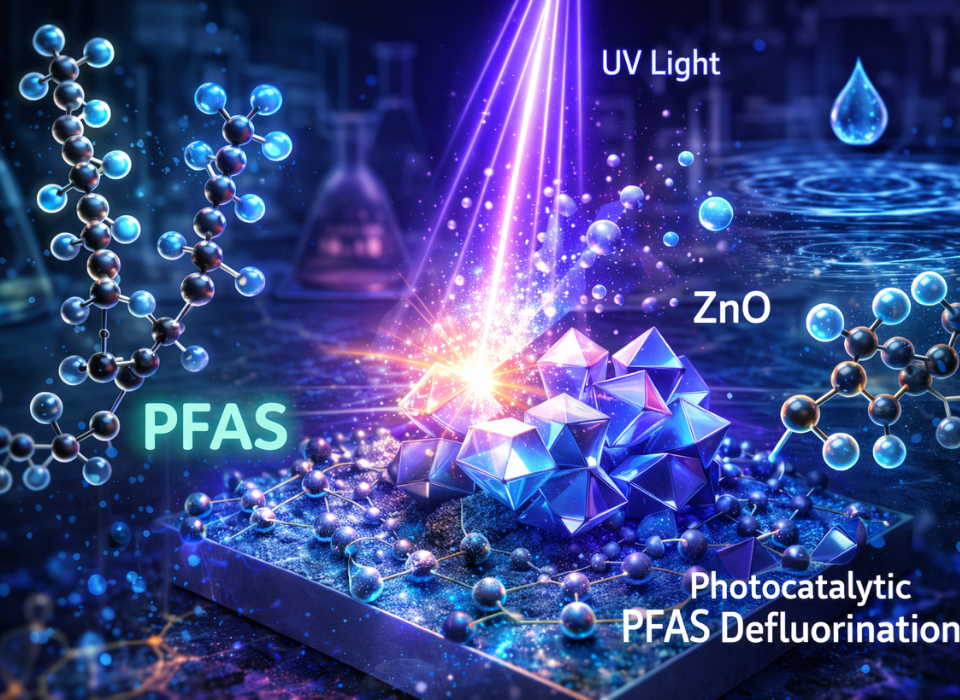
Perfluoroalkyl substances (PFAS), a broad class of synthetic chemicals, are valued for their resistance to heat, water and oil. These materials are used in the production of industrial products as well as everyday items. PFAS molecules consist of a chain made up of interconnected carbon and fluorine atoms.
Per- and polyfluoroalkyl substances (PFAS), a broad class of synthetic chemicals, are valued for their resistance to heat, water and oil. These materials are used in the manufacture of industrial products as well as everyday items. PFAS molecules consist of a chain made up of interconnected carbon and fluorine atoms. The energy required to break the carbon-fluorine (C-F) bond is extremely high; this makes these compounds durable and highly resistant to biological degradation. However, because PFAS do not break down easily, they are often referred to as "forever chemicals". This persistence leads to continuous pollution and bioaccumulation, raising global concerns about long-term exposure and contamination cycles for ecosystems and humans.
Challenges in PFAS degradation and new approaches
PFAS defluorination is the process of removing fluorine atoms from the molecule; this process makes the molecule less stable and more susceptible to further breakdown. Traditional PFAS degradation techniques are challenging because they require harsh chemicals or high energy. New, sustainable and energy-efficient methods need to be developed to enable PFAS recycling and reduce PFAS-related environmental risks. A new study led by Professor Yoichi Kobayashi from Ritsumeikan University in Japan and conducted with Mr Shuhei Kanao, also from the same university, investigated the potential use of zinc oxide (ZnO) nanocrystals (NCs) in the PFAS defluorination process. Known for their photocatalytic properties, NCs can use light to create reactive species that break down organic pollutants. To increase efficiency, NCs coated with different ligands were used. The study was published as a communication in Chemical Science.
Study focus and experimental details
Prof. Kobayashi said, "Perfluorooctane sulfonic acid, or PFOS, is a PFAS compound that was once widely used but is now strictly regulated; we wanted to see if ligand-coated ZnO NCs could defluorinate it." The study primarily focused on the defluorination efficiency of ZnO NCs coated with acetic acid (AA-ZnO NCs) or 3-mercaptopropionic acid (MPA-ZnO NCs). For comparative analysis, several other organic ligands were also used to coat the NCs. The defluorination experiment was carried out using 365 nm LED light, as it mimicked ambient lighting conditions. The defluorination effect of these ligand-coated NCs was also tested on several other PFAS such as trifluoroacetic acid and Nafion.
Key findings and conclusions
AA-ZnO NCs were able to efficiently defluorinate PFOS when irradiated with near-UV light under ambient conditions. The presence of the acetic acid ligand proved to be much more efficient than 3-mercaptopropionic acid; while MPA-ZnO NCs provided only 8.4% defluorination after 24 hours, AA-ZnO NCs exhibited a defluorination rate of up to 92% after 24 hours under optimized conditions. Their durability and decrease in catalytic efficiency over time were tested to ensure the sustainability of these NCs. Findings showed that the decomposition reaction continued over multiple cycles and that a single ZnO NC was able to break up to 8,250 C-F bonds, indicating its reusability. ZnO NCs can be used efficiently in the defluorination process due to their unique properties. Unlike many previous catalysts, they have low toxicity, are inexpensive and can be produced on a large scale. Mr Shuhei Kanao said, "The reaction takes place at room temperature and does not require expensive, fragile or potentially hazardous high-energy light sources." This mild photodegradation system has the capacity to solve the critical PFAS recycling problem on a global scale. It can be used in combating industrial PFAS pollution as well as in fluorochemical material production plants, semiconductor production plants, recycling industries, wastewater treatment facilities and more.
Prof. Kobayashi concluded by saying, "PFAS pollution is a concern worldwide and this simple NC-based technology could contribute significantly to addressing this problem."
Source
Publication details
Shuhei Kanao et al, Photocatalytic defluorination of perfluoroalkyl substances by surface-engineered ZnO nanocrystals, Chemical Science (2025). DOI: 10.1039/d5sc05781g
Journal information: Chemical Science
https://phys.org/news/2025-12-surface-zno-nanocrystals-tackle-perfluoroalkyl.html
Gallery