We spoke with Emre Vatansever, Founder Partner and General Manager of Evakim Paint Shop Solutions, about sector concerns and products designed in-house.
Could you briefly introduce yourself?
I was born in Eskişehir in 1978. I completed my education at Kadıköy Anatolian High School in Istanbul and at Uludağ University. In 2006, I started working at a Toyota paint shop. Since then, I have been working on paint shops.
Evakim delivers engineering solutions that create a difference in the sector. What are your innovative approaches in paint facility design?
Fundamentally, our approach to paint facilities is to view them as a whole rather than addressing them section by section, such as booth, oven, and so on. We ensure that the facility operates with high efficiency by keeping the facility's expectations (losses, yield, maintenance, etc.) within predictable limits during the design phase. For this reason, many customers who have entered the painting process with Evakim are noteworthy. On the other hand, particularly in plastic part paint shops, we closely follow robotic applications and surface pretreatment technologies such as ostrich feather, plasma, flaming, CO2 and fluorine, as well as the latest developments in Europe in paint transfer systems, in order to present these to our customers in our projects.
Among the solutions you offer for optimizing existing facilities, which applications are most in demand?
In the optimization of existing facilities, the most common problems we encounter are paint booth balance issues. The biggest problems created by an unbalanced paint booth for operations are increased product losses and maintenance requirements, rising labor costs, and most seriously, direct fire hazard due to paint accumulation in the exhaust line. The applications most requested by our customers are improvements to booth balance, booth wash and ventilation systems. In some cases, improvements can be achieved through adjustments, but for design-related problems, unfortunately, renovation is the only solution we can offer.
What kinds of innovations are you making in the procurement of chemicals and equipment to enhance the performance of paint booths?
This topic needs to be addressed in two separate items: First, since 2006, Evakim has been manufacturing its own design and manufacture of paint sludge separation systems. The treatment systems we have manufactured are used in many primary industries in our country, as well as in automotive companies in Poland, the Netherlands and France. We are continuously working to improve the design of these systems and adding innovations such as sludge dewatering systems and PLC recipe-based dosing systems.
We also manufacture chemical products such as paint thinners and floatants that must be used in paint booths. At this stage, we are the only company capable of serving with three different product groups with different architectures in the paint sludge remover and thinner product range. Among these products are clay-based (brown product), polymer-based product, and environmentally friendly starch-based product called "green" product, which has recently begun to be used in Europe.
What are the advantages of your 6-axis paint robot applications implemented with brands such as ABB, Fanuc and Staubli?
Since our first paint robot experience in 2014, we have implemented dozens of robot installations from different brands, including 6-axis and linear painting robots. In recent years, with increasing production loads and lack of skilled personnel, the requests from our customers, whether powder paint shops or wet paint shops, have been predominantly for robotic applications.
The robotic systems we are establishing provide our customers with uninterrupted, controlled and OHS-compliant production through the combination of paint transfer systems and production recipes. Robotic applications, which can also be equipped with automatic field scanning systems, can operate on a product recipe basis and can also provide data on how many parts were painted and how much paint was consumed at the end of production.
Along with standard 6-axis paint robot applications, we also provide our customers with 2, 3 and 4-axis linear painting robots of our own design and manufacture integrated with the paint transfer system. In addition to the work we have done in this field, to develop product diversity, we also act as the Turkey representative of CMA Robotics, one of the oldest companies in its field in Italy, a teachable robot manufacturer with 6, 7 and 8-axis solutions for use in powder paint and wet paint shops.
How do your process engineering services make a difference, particularly for wet and dry filtered paint booths?
Whether it is a one-meter wide laboratory-type test paint booth designed at Evakim or complex paint booths where different types of paints are applied, all are manufactured within the scope of booth engineering. Rather than responding to the requests coming to Evakim with standard solutions, we try to produce solutions by getting answers to the questions of what we will paint, how we will paint it and how many we will paint.
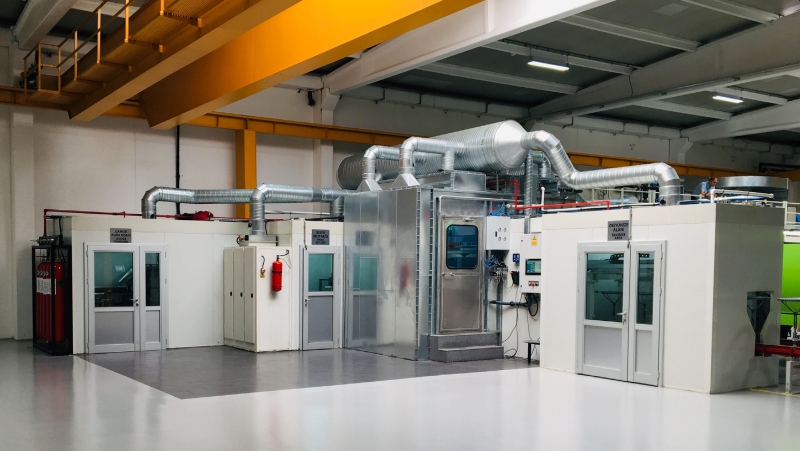
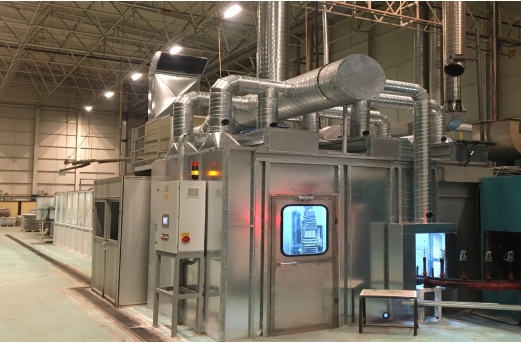
When it comes to wet and dry filtered paint booths, if standard paint application without shift work is the issue, our recommendation is our own design and manufactured dry-type filtered paint booths. Unlike their counterparts, in our dry-type booths, instead of long-standing solutions such as accordion or fiber filters that have no benefit for booth balancing, we offer solutions with our own design and manufactured paint-capturing filters whose saturation rates can be monitored in the automation system. This is because it is not possible to control and monitor the saturation rates of fiber or accordion filters.
Dry-type filtered paint booths are manufactured from galvanized material and, since they do not require welding in manufacture and assembly and do not require equipment such as treatment pumps compared to water filtration systems, they offer major advantages in terms of investment cost and operational cost. Our own design Evakim water curtain paint booths can also be manufactured from 1 meter wide to 8 meters wide. These systems operate at approximately 1000 mpa exhaust pressure and, unlike classical methods, have no wash or nozzle system behind the water curtain and have the capacity to pass 99 percent of waste paint (overspray) produced during paint application through the wash.
What are the solutions you offer to improve energy efficiency in industrial paint shops?
We use standard conveyor solutions depending on project requirements, as well as our own conveyor solutions manufactured specifically for the project. Regarding the oven, against the general standard for wet paint of 80 degrees curing for 30 minutes, depending on part architecture, our electric infrared ovens that we support with our own solutions provide a 15-minute curing advantage instead of 30 minutes and have been used trouble-free in plastic part paint shops for a long time. The greatest advantage of electric IR is that there is no "warm-up" issue. That is, the IR ovens we have installed can be turned off even for a tea break and production can continue without delay from where it left off after the break.
How do you contribute to environmental sustainability in the design and implementation of paint sludge separation systems?
In addition to the effect of wet paint booth treatment systems on process stability, they also have advantages such as compliance with OHS regulations, waste management compliance and wastewater recovery. In particular, our environmentally friendly "green" starch-based product can affect the quality and classification of paint sludge obtained from the paint booth. We have systems that operate for more than a year without water changes and without manual booth cleaning in systems where we can meet technical requirements.
Gallery