SYTENOL A: The Only True Natural Alternative to Retinol

Sytenol®️ A
As skin ages, it loses elasticity, becomes thinner and weaker, and develops a tendency toward wrinkles and hyperpigmentation. How can this be prevented? The primary goal of anti-aging products is to reduce the appearance of fine lines and wrinkles and eliminate them over time, while also evening out skin tone. The most effective way to achieve this is to prevent wrinkle formation from the outset. This means protecting the skin from further damage, restoring the extracellular matrix (ECM) and dermal-epidermal junction (DEJ) regions, and preserving skin moisture.
Product Information
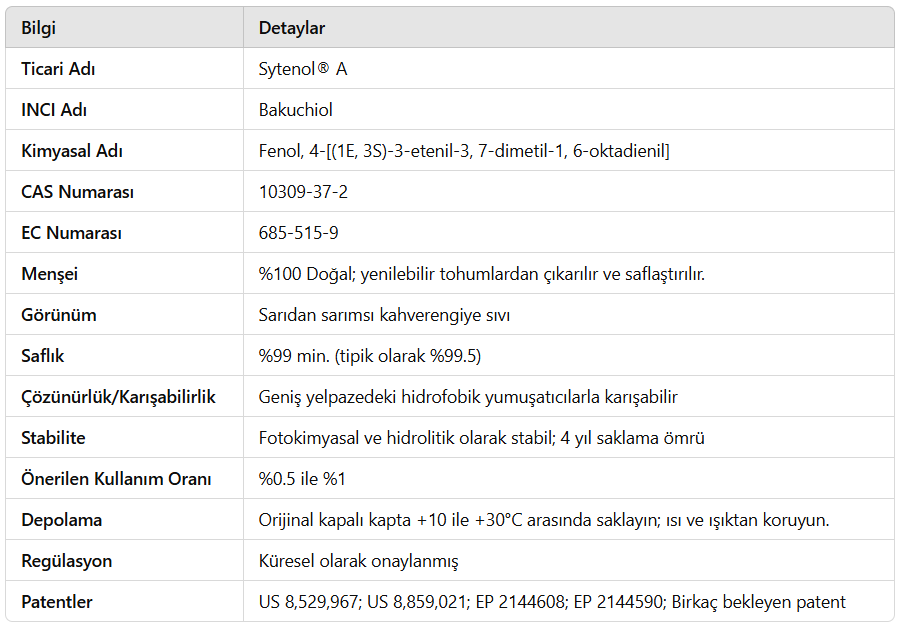
Sytenol®️ A - A Functional Equivalent to Retinol
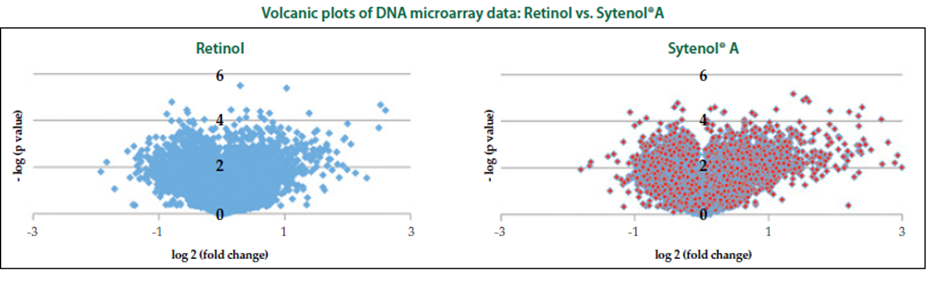
From the perspective of topically applied formulations, a small molecule that lacks the negative characteristics of retinol but safely mimics its properties is a highly sought-after ingredient. Volcanic plots show the molecular signatures of Retinol and Sytenol®️ A. A DNA microarray study using full-thickness epidermis produced a similar overall pattern, demonstrating similar overall modulation of gene expression in the skin model. Multiple comparative studies have shown that Sytenol®️ A is a genuine alternative to Retinol (Chaudhuri, Cosmeceuticals and Active Cosmetics, 3rd Edition, Eds., Maibach et al., 2015). Studies have demonstrated that Sytenol®️ A has safety and stability advantages for anti-aging applications. A recent randomized, double-blind clinical study conducted by UC-Davis dermatologists showed that both Sytenol®️ A and Retinol significantly reduced wrinkle surface area and hyperpigmentation, with no statistically significant difference between the compounds. Retinol users reported more facial skin peeling, burning, and stinging. The authors concluded that Sytenol®️ A is a more tolerable alternative to Retinol (Dhaliwal et al., British Journal of Dermatology, 180:289-296, 2019).
Clinically Proven Reduction of Multiple Signs of Aging
Protocol:
- Human volunteers: 17; 16 completed; Age range: 41 - 60 years; Caucasian (14), Hispanic (2)
- Study duration: 12 weeks
- Test area: Entire face
- Test substance: Lotion containing 0.5% Sytenol®️ A; does not contain sunscreen or moisturizer
- Application frequency: Approximately twice daily
- Methodology: Panelist evaluations / Self-assessment (rating scale 0 to 4): (1) Dry skin and dryness, (2) Fine lines and wrinkles, (3) Skin tone, (4) Skin elasticity and firmness, (5) Radiance, (6) Brightening, (7) Overall eye area appearance; Silicone replica analysis: Wrinkle depth and skin roughness; Photography: Before and after treatment; Measurements taken at weeks 4, 8, and 12.
- Statistical analysis: Statistical significance defined as p ≤ 0.05.
Results
The results clearly demonstrated significant improvements in wrinkles, pigmentation, elasticity, firmness, and overall photodamage following twelve weeks of treatment. There were no irritant effects on the skin. Based on these results and comparative studies conducted with Sytenol®️ A, we concluded that Sytenol®️ A is the first true retinol-like anti-aging product (Chaudhuri & Bojanowski, Intern J Cosmet Sci, 36(3): 221-230, 2014).
Subject M535:
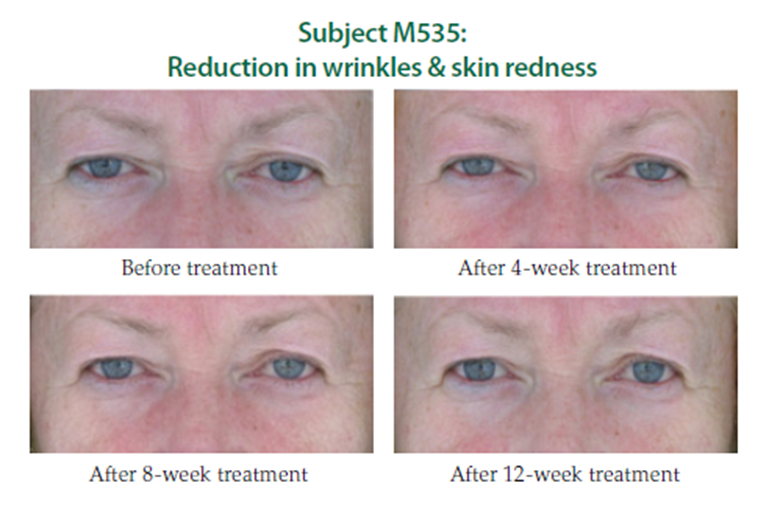
- Reduction in wrinkles and skin redness
- Before treatment
- After 4 weeks of treatment
- After 8 weeks of treatment
- After 12 weeks of treatment
Subject M572:
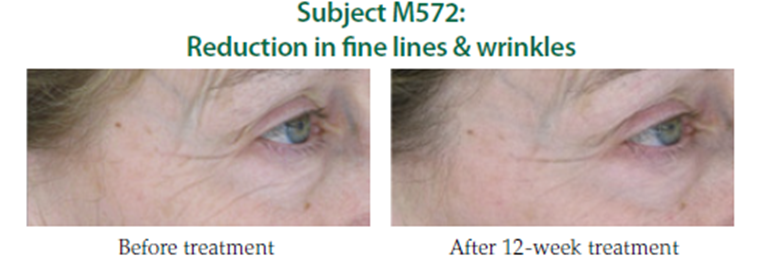
- Reduction in fine lines and wrinkles
- Before treatment
- After 12 weeks of treatment
Restorative Anti-Aging Effect
Comparative Collagen Stimulation Effects
In aging skin, exhausted fibroblasts produce collagen at low levels and have high levels of collagen-degrading enzymes. This imbalance accelerates the aging process in a continuous, relentless harmful cycle. It has been clinically proven that treatments such as topical retinol or retinoic acid stimulate the production of new, undamaged collagen (Fisher et al., Arch Dermatol, 144(5):666-672, 2008). Fibroblast adhesion to this new collagen provides elasticity, which in turn balances collagen production and degradation, thereby slowing and even reversing the aging process. We measured collagen stimulation using ELISA and histochemistry methods. In ELISA evaluation, conditioned medium from cell cultures derived from neonatal (type I & IV collagens) or mature (type III collagen) fibroblasts was used (Chaudhuri & Bojanowski, Intern J Cosmet Sci, 36(3):221-230, 2014). The results of these findings summarized in the table below (% stimulation versus control) showed that Sytenol® A demonstrated significant improvement in collagen stimulation compared to Retinol, and therefore greater restorative effect is expected.
Test substance (10 µg/ml) Collagen I Collagen III Collagen IV
Sytenol® A 147 150 119
Retinol 119 148 100
Defense Against Inflammation
There is a close relationship between skin aging and inflammation. Inflammation is a complex process that results in acute inflammation becoming chronic. This condition impairs the skin's barrier function, increases collagen degradation, and leads to signs of aging such as wrinkles, hyperpigmentation, and loss of elasticity.
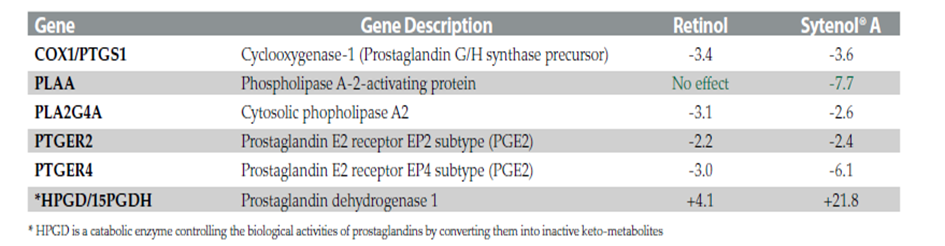
In this study, the anti-inflammatory effects of a compound called Sytenol A were examined. Sytenol A demonstrates this effect by inhibiting the expression of pro-inflammatory genes and reducing the activity of inflammatory enzymes.
Downregulation of Pro-Inflammatory Genes
- Tissue and Method: Full-thickness human epidermal tissue was used. Solutions containing Sytenol A and Retinol were applied to the tissue.
- Results: Sytenol A more effectively reduced the expression of pro-inflammatory genes compared to Retinol. The decrease in COX2, PLA2G4A, F2R, TGFB1, and FCER1G genes is particularly noteworthy.
Formulation Guidelines
Sytenol A is a lipophilic compound soluble in a wide range of emulsifiers. It can be dissolved in systems such as caprylic/capric triglycerides, Hydroxyethyl Cellulose, Isoket-5, ethyl acetate, squalane, jojoba oil, and olive oil. Sytenol A is dark yellowish in color but does not affect the color of the formula.
Sytenol A can be easily formulated:
Cream: Emulsifiers such as fatty alcohol, sorbitan esters, and cetyl alcohol can be used.
Lotion: Hydro-alcoholic systems (0.5 to 1.5% w/w) can be used.
Gel: Sytenol A can be used directly in hydrogel.
Oil: Sytenol A can be used directly in the oil phase, but cannot be used directly in silicone-based products. Both products can be prepared separately and then mixed.
Important notes:
Avoid heating above 75°C for extended periods.
Adding 0.1% chelating agent (for copper fixation) may be beneficial.
The bluish color that forms during manufacturing is likely due to copper or iron contamination.
Sytenol A formulation can degrade when exposed to heat and light.
Sytenol A can be formulated with PEG-40 hydrogenated castor oil, Poloxamer 20, and other surfactants.
Author: Gülden Değirmenci
Technical Sales Manager - Personal Care / Orbiter Solutions
Gallery