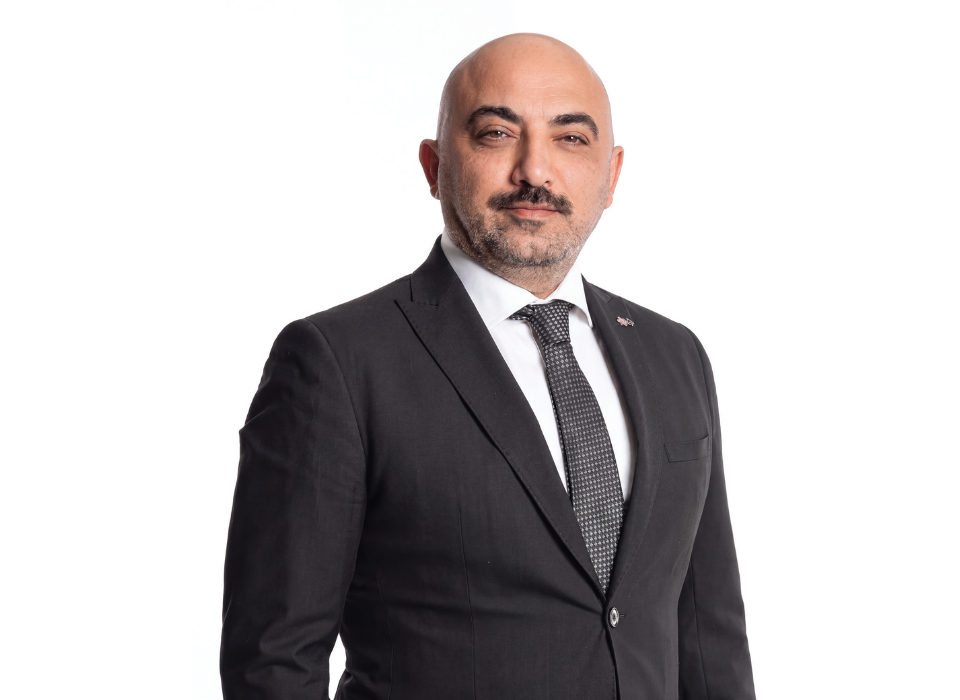
In our senior series' industry feature, we welcome V. İbrahim Aracı, Chairman of Koruma Şirketler Grubu and a leading figure in Turkish chemical manufacturing. V. İbrahim Aracı has built dozens of successes throughout his business career that began at a young age, while also crafting a fulfilling life with his family, grandchildren, sports, travel and his beloved horses. We hope you enjoy our conversation, which has been a rich source of inspiration...
I'd like to start by learning a bit about your childhood and the family you grew up in...
I was born in 1959 in the Yukarıpazar Turgut neighborhood of İzmit, as a child of a middle-income family. My older brother and sister were born during a period when my family's economic situation was weaker and they were working for another company. The year I was born, God granted my father the opportunity to establish his own company. During my childhood, İzmit consisted of very beautiful neighborhoods made up of wooden houses. I spent my childhood playing among the neighborhood streets, living a full childhood. I can't say I was a well-behaved child—I was quite a mischievous one. I spent my time playing every kind of street game imaginable, from marbles—which you rarely see today—to steel rods and ball games. I loved playing marbles. I even traveled to different neighborhoods for marble matches. My father would occasionally scold me for this. I had boxes full of marbles. I both played with them and sold them. Perhaps my interest in commerce began then. Despite my father working late hours, he wanted us to be home by a certain time. Out of four siblings, I was the only one who consistently exceeded that curfew.
Later, we moved to a historic house in Kozluk, one of İzmit's oldest neighborhoods, where I lived until I was 18 years old. I attended Necati Bey Primary School. One never forgets their primary school teacher, and I remember my teacher Orhan Buğdaycı Bey with respect. Our father had a great sensitivity toward orphans because he came to Turkey as an orphan himself. He wanted us to carry this sentiment, so the three of us brothers—apart from our sister—attended school near an orphanage. Then came my middle school years at İnkılap Middle School. After that, I started playing basketball at Kağıt Spor, a very successful sports club in Kocaeli at that time. During military service, I served as a basketball player at the Muhafız Gücü Sports Club. Though the current generation may not know it, Muhafız Gücü was one of the most important clubs of that era. Although I was accepted to university, in 1976, due to the turbulent atmosphere of the time, I chose to work with my father and began my business life. My parents were people deeply devoted to family. They made sure we didn't feel either wealth or hardship too keenly. My father was very charitable. After losing him, we continued this quality. Through social responsibility projects such as a school in my father's name and an oncology hospital in my mother's name, we continue to keep them alive in our hearts.

How did you take your first steps in business?
I began my business life working with my father in our transportation warehouses. I developed that business and began entering logistics operations for important establishments in Turkey. After 1980, particularly during the late Özal's period with the export boom, we were loading goods from factories morning and evening. Because I visited factories frequently while engaged in transportation work, I was very interested in manufacturing. While running the transportation business, I would pay attention to different sectors and think about what I could produce. First, I started producing steel wire. Initially for bedsprings, then for automobile suppliers, and I developed that business considerably. During this period, I didn't abandon the transportation business. Sakarya Nakliyat, which I founded, grew day by day, becoming a company that handled logistics for both our own factories and some outside firms. While managing the logistics business, I simultaneously focused on manufacturing, working with the thought of what other projects I could implement and how I could develop the business.
Could you tell us about the process of acquiring Koruma Tarım?
Actually, we didn't take over or purchase Koruma Tarım A.Ş. We may not have explained this well so far, but let me clarify here. Our logistics company, then called Koruma Endüstri Ürünleri A.Ş., handled salt and pesticide transportation logistics. When Koruma Factories closed at that time, Turkey faced a serious acid shortage. Since we were in the steel wire business, both we and other firms in the sector couldn't find acid for surface cleaning of steel wires. During that period, because both importing and transporting this material was problematic, we could only find acid in exorbitant quantities and small amounts. When this situation hampered our work, we began looking for solutions. In 1994, Interbank offered for sale eight plots of land with a factory building on top, part of Koruma Endüstri Ürünleri A.Ş. in Kocaeli, against an Interbank debt. We went to Interbank explaining our acid shortage, asking them to let us operate that factory, and they responded with 'Why don't you consider purchasing and operating this factory?' Until that moment, I had never considered such a thing. We went to Interbank to secure acid so we could work comfortably, and we left as factory owners. I established a new company called Klor Alkali Sanayi ve Ticaret Anonim Şirketi from scratch and purchased these eight plots of land from the bank. Later, when Koruma Şirketleri was removed from the commercial registry, I simply added a Koruma designation to the head of our own company. Because the area where the factory is located was known by the name Koruma, and even the bus stop was named Koruma, we thought adding the Koruma designation would facilitate accessibility. Because Koruma was a very well-known and trusted brand, especially in Anatolia, for agricultural pesticides, we wanted this name to continue even if management changed, with the principle that 'Turkish industry will remain with Turkish industry.' So there was no situation of us purchasing the old Koruma companies, as far as I know, those companies went bankrupt.
After entering the chemical industry, how did you succeed in a sector you didn't know?
After entering the chemical industry, I can say I lived in the factory we established for three years. We did everything from all the buildings to all the production processes from scratch. Following our Kocaeli factory, we added our Hatay factory, and after our Hatay factory, we added our Denizli factory to our facilities.
Was establishing factories in three different regions a strategic decision?
It was definitely a strategic decision. The 1999 earthquake showed us the necessity of having other factories active if our production stopped or shipments couldn't be provided from one factory. Some of the products we produce are vital products used in municipal drinking water treatment. God forbid, if a region faces difficulties in Turkey, we wanted other regional factories to be in working order. That's one of the most important reasons. Second, our products are materials that must be transported with special vehicles. Vehicles from Kocaeli going to Adana or Urfa were returning empty. You're transporting a product worth 150-200 dollars, paying roughly the same amount in transportation costs, and the vehicle returns empty. This seemed very illogical to me. With the establishment of the Hatay factory, our reach to provinces like Gaziantep, Adana, Mersin, and Kahramanmaraş in that region became much easier. Our average transportation distance, which was 750-800 km, fell below 200 km. Again, if you consider the Antalya-İzmir triangle, regions with high concentrations of swimming pools, textiles, and therefore heavy use of our products, thanks to our Denizli factory, we became able to reach these regions easily. We never left our customers without products, and at the same time, we didn't pressure them to hold excessive inventory. Because when they called in the evening, they could access our products by morning. Some of our products that lose their active chlorine when exposed to heat were appreciated by companies in hot regions. A third consideration was the thought that producing large quantities of chlorine in one location would carry greater risk, so to mitigate this, we established our factories in three different regions through a strategic decision. Now our fourth factory is also being completed in the organized industrial zone.
What are your targets for the near future?
We have a plant protection products division. After establishing Klor Alkali, we began registering all pesticides from scratch. Regarding agricultural pesticides, we've made every investment we could. My brother Kemal, in particular, is an excellent civil engineer, yet he's also very interested in agriculture. Following his extensive research, we became the first company in Turkey to produce technical bacteria. We're competing with China in this field. Healthy and productive agriculture requires plant protection products to be a very important issue for our country. While we continue new pesticide registrations on the agricultural side, on the other hand we're planning to add fertilizer to our products. We aim to do this through production, not through imports. I believe we will gain momentum in that field within the next three years. We don't prefer growing by taking on excessive credit and debt. While we continue chlor-alkali product production at Hatay, we've decided to establish a hydrogen peroxide facility. Our target is to move into production by the first half of 2025 at the latest. Again in Hatay, among our targets is resuming powder chlorine production, which Turkey heavily imports and which we paused after the earthquake. Additionally, within one year our percarbonate facility will come online. Beyond that, we have projects to produce certain products at our facilities that are not currently produced anywhere in Turkey. When we complete their licensing agreements, we'll have taken a step that will largely free our country from imports. In the Koruma Temizlik group, through new agreements we've made, we're also entering the packaging sector. We will now be producing the packaging for our own manufactured products. New products are also coming to Koruma Temizlik.
What do you do to catch your breath amid all this intensity?
First of all, I can say that between my intense work pace and especially following the earthquake disaster we experienced, with the demoralization and sadness we felt, I didn't have much time to catch my breath in 2023-2024. But whenever I have the chance, I want to spend time with my grandchildren and daughters. Sports play a very important role in my life. I do walking and running. I love diving. My daughters and I dove quite a bit in various countries until 2023. My main hobby, however, is horsemanship. I love breeding horses.

The sweetest part, I'd say, is thinking about which mare to breed with which stallion at the right time, getting which offspring, keeping their family pedigrees in mind, studying this like a lesson in the evenings, and then seeing the success of the foals born. Although I haven't had much time for this in the last two years, I watch training videos and follow closely. If I can dedicate an entire day to horses, that's when you can really get away from work a bit. I'm determined that after we complete our current investments, post-2025 I want to put more emphasis on horsemanship and bring it to a level where it can make serious contributions to Turkey's economy.
When you look at the chemical industry in Turkey overall, what picture do you see?
First of all, I'm not a chemist. After entering the chemical industry, I understood how important chemistry and chemical products are. All developed countries have strong chemical industries. Switzerland's chemical exports are about four times ours. Switzerland has no oil either. Because we don't have oil, we have chemical production that is highly dependent on imports in many chemicals. If you ask for my personal opinion, as a country, we don't like chemistry. If someone says they're establishing a textile factory in a region, there's no reaction from the public. But if someone says they're establishing a chemical factory, they immediately face opposition. That's why the need for clustering in Turkey's chemical industry arises. However, when you try to create such an ecosystem, you constantly face resistance in finding land and obtaining the necessary permits. Meanwhile, the chemical industry exported 32 billion dollars last year. Using our advantages of logistics, a young population, and bold entrepreneurs, we could accomplish much greater things. We need to reduce our dependence on raw materials from abroad. This absolutely requires state support at this point. We need to identify locations, and through licensing agreements or R&D work, produce our raw materials. I don't believe that without a chemical industry, any industry in Turkey will reach the highest level of competition. For example, you say you'll produce automobiles. Automobiles have plastic everywhere, from seats to bumpers. Chemical products are used in the production of the materials used. You'll clean the automobile factory's waste with chemicals. You'll treat it with chemicals. Clustering is very important for the chemical industry. Creating an ecosystem within this clustering is very important. Starting with local governments, the state and people need to genuinely warm to chemistry, to love it. Chemistry industry products are in cosmetics, in the perfume you use, in the products you use to keep your home clean, in everything in your kitchen. I believe that one day our people will sincerely accept this and won't oppose the establishment of facilities. This is one of the most important requirements for our development. That's why we need to strongly support the chemical industry. GEBKİM OSB is therefore very important.
So at exactly this point, could you briefly summarize the importance of GEBKİM and its founding purpose?
Foreseeing the pivotal role of the chemical industry in development and the strength that meeting on common goals would provide to our country, GEBKİM was established with forward-thinking vision and entirely financed by manufacturers, creating a model that, as Turkey's first specialized chemical industrial zone, has become an example not just for our country but for chemical industry investments in our nearby geography. GEBKİM has demonstrated that it's possible to create clustering in the chemical industry and establish an ecosystem. That's why it's very important in the first place. New investments in our region have also begun coming online one by one. As you know, we invited Tatneft to our country to produce maleic anhydride. In 2025, they will begin production at GEBKİM and will produce 50,000 tons annually. At least 30,000 tons of this will be consumed within that ecosystem in our organized industrial zone.

The refined product coming out of that ecosystem will partly be consumed within our organized industrial zone, reaching the final product. This is what China does today. It creates a raw material hub factory and supplies raw materials to other companies through pipeline networks. This needs to increase. Look at Europe's, America's, Japan's development—strong chemical industries lie at the foundation of all of them. We need to carry our chemical industry to higher levels by producing more value-added products, reducing imports, and increasing exports. Chemical specialty industrial zones that support this need to definitely be established in the GEBKİM model.
What would you like to say about energy consumption in the chemical industry?
Our energy costs are very high. In our own case, we're trying to invest in solar energy as much as possible. Our Industry Minister recently said in a speech, 'What if we gave solar energy permits not to shopping centers, but to companies that can produce in Turkey the products our country imports?' I completely agree. Electricity is crucial for us. Because of the low energy costs in Egypt and Iran, they can produce products much cheaper than us. We have sunshine too. If I invest in solar energy as Klor Alkali and use the electricity I produce in electrolysis, I can compete more with them and could reduce imports or even export. That's why, through your medium, we should communicate our request to the state for energy permits, clustering, ecosystem creation, and land allocation support.
With GEBKİM Vocational and Technical Anatolian High School, you're also aiming to find a solution to the chemical industry's need for skilled workers.
Our initial goal was to establish a school within the industrial zone, proceeding from the idea that education is important. To be honest, at that time there wasn't yet such an intense need for skilled workers. The industrial zone hadn't yet reached sufficient capacity. We developed a previously abandoned school to its current state. Each company established 12 laboratories in their own field. Our students have classes in 12 laboratories. They're not just doing experiments—they're actually taking lessons there. We also established a pilot production facility. Professionals from the industrial zone occasionally visit and assist. We also greatly improved our school's physical conditions. We paid great attention to every aspect, from our students' uniforms to their transportation to their meals. After our students graduated, we conducted statistics to see how many preferred to work in the chemical sector and found the number very small. Some have chosen to go to university, of course we deeply respect that, while others say, 'You gave us such excellent education that our English is perfect, you taught us automation, you taught us computers. With this education I can work in an easier sector.' However, recently we've begun to see the slow benefits of human resources fairs and job fairs. We also prepared a portal as GEBKİM. We're thinking of creating an ecosystem where GEBKİM graduates meet. We need to place great emphasis on technical schools and vocational schools. We need to explain to families and children this: Finding work as a university graduate, believe me, is more difficult. I have no difficulty finding university-educated people. But I can no longer find technical colleagues to operate our factories. This will be the profession of the future. These colleagues will find jobs with much higher income and job security. I began our conversation by speaking of the commerce that I started with transportation. Let me tell you something sincerely now. A sack of rice weighed 120 kilograms, a piece of fabric weighed 250 kilograms, and we carried these on our backs. We did. Now you can't make packaging heavier than 25 kilograms. Should it be this way? Yes, it should be. That's why our young people should know that the difference between entering a factory as an engineer and entering as a technician, due to new organizations, new designs, and new conditions being created, is no different. Every employee has the same atmosphere and rights. While there are exceptions, the state's inspections are reducing these exceptions. Future professions will favor people who can use a few tools. Our technical school graduates will have the option to choose jobs. A university graduate won't have many such options. But an automation technician, an electrical technician can easily find work throughout Turkey. An environmental engineer brother won't find work in every factory. My plea to our youth is please and please do consider vocational schools and technical high schools seriously. I also have a role at the Deniz Chamber of Commerce. At the Maritime Vocational High School, we're now training the chief engineers and sailors of the future. Their economic conditions will be much better and they'll have much more job potential. We've set this as our goal at GEBKİM MTAL.
Now that you've mentioned GEBKİM MTAL, I suppose I should ask about your foundation...
Yes, as GEBKİM we established a foundation. This is not the foundation of a person or a company; it's entirely the foundation of the Organized Industrial Zone. It will continue after us as well. All our industrialist colleagues supported it. In all disasters experienced in our country, our foundation did its part. Our foundation finances our school. We also established a kindergarten. Because we greatly value our female employees. This kindergarten became an ambitious school that our workers can comfortably send their children to. I can say it's a school I would want to send my children and grandchildren to if they were in that region. This was also a very nice service, I believe. An hotel of ours will be completed soon. God willing, we will continue to provide better service to the chemical industry.
You also place great importance on technology and innovation. Could you briefly tell us about GEBTEK's activities?
As GEBKİM Specialized Chemical Industrial Zone, we conduct many activities to support our companies in terms of compliance with the European Union's Green Deal process, digitalization, new technologies, investments that will increase value-added products, and R&D work. The reflection of our vision on this subject is GEBTEK Technology Development Center, among our most important projects. Technology is now essential. We must separate artificial intelligence from technology itself as a separate matter. We provided mentoring there. We also support the young team with mentors. We provide training to our members in the Organized Industrial Zone. We offer training on tracking carbon footprint. Another branch of GEBTEK is human resources. Companies both currently based in and newly establishing in the industrial zone have human resource needs. Today, industry in Dilovası employs three times the population of Dilovası. Significant development will also begin soon. Because many people commute from Istanbul to here. There's serious work being done related to transportation and rail systems. When we do these things, all the sectors here will become more ambitious sectors.
Is there anything else you'd like to add in conclusion?
The issue I especially want to emphasize is that Turkey needs a main organization to represent the chemical industry. Particularly and primarily, we need an institution to represent the domestic industry. I think international chemical industry prefers that certain developments don't occur in Turkey. In truth, I sincerely wish for an institution that won't let certain low-cost chemicals be monopolized and won't sacrifice Turkey's market share. For instance, KİPLAS, despite being an employers' confederation, takes this very seriously. But we need an institution that focuses only on chemical industry investments. I have no doubt that Turkey's chemical industry will sit in first place in exports with the momentum this institution will create. And God willing, that will be the case.
- - - - - - - - - - - - - - - - - - - - - - - - - - - - - - - - - - - - - - - - - - - - - - - - - - - - - - - - - - - - - - -
Interview by: Gamze Ünal
Images by: Oğuzhan Dağıstanlı
Gallery