GEA Unveils World's Smallest Single-Use Disc Centrifuge

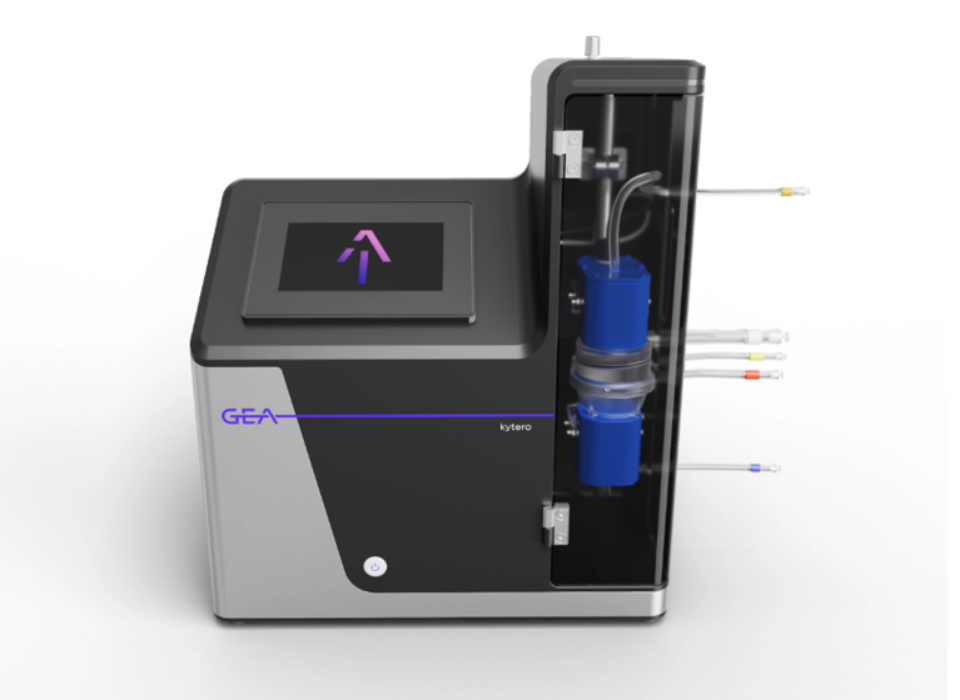
GEA has introduced the kytero® 10, the world's smallest single-use disc stack centrifuge. This mini centrifuge is used in the biopharmaceutical, food and novel food industries, particularly in product development processes where only small bioreactor sizes are typically available.
GEA introduced the kytero® 10, the world's smallest single-use plate centrifuge. This mini centrifuge is used in biopharma, food and novel food industries, typically in product development processes where only small bioreactor sizes are available.
Its function is the separation of bacteria, cell cultures and yeasts as well as applications in cell and gene therapy. The kytero® 10 is the smallest model in GEA's product range for cell separation and recirculation, suitable for volumes between 1 and 10 liters. Thanks to its low shear force design, high cell viability is possible during continuous cell harvest and perfusion processes using the centrifugal separation method, from laboratory scale to production scale. The kytero® 10 separator is ideal for the smallest batch and perfusion fermenters.
Test Users: Previous Limits Overcome with Scale-Up
Other models in the kytero® series cover the 500 to 2,000 liter (batch) range. Test users have found that this concept overcomes previous limitations. The results obtained can be scaled to larger model variants and to industrial production with classical stainless steel separators, which facilitates process transfer and validation.
High Contamination Safety with Single-Use Design
Proven GEA plate centrifuge technology has been applied in easy-to-use compact units containing all product-contact parts. These units are replaced after a production run, providing maximum contamination safety. Gamma-sterilized replaceable units are available as standard.
No Complex CIP and SIP Cleaning, Innovative Drive System
The new single-use perfusion separators offer the same advantages as classical plate separators, but do not require cleaning procedures (CIP - clean-in-place and SIP - steam-in-place). Ready for the next operation in just a few minutes, requiring only electricity and air. Thanks to its compact design and easy, self-explanatory operation, it provides simple operation in any system. The contactless drive system breeze Drive®, guarantees safe operation under high biosafety requirements.
First and Only Single-Use Plate Perfusion Centrifuge at Laboratory Scale
The new kytero® 10 separators enable continuous operation during the perfusion period and continuous clarification of fermentation broth. The clarified broth containing the product is typically continuously removed from the process and transferred to the next stage. Exceptions are bacterial processes where cells are the valuable product and novel food applications. The concentrated biomass is gently recycled back to the bioreactor, providing high viability and efficiency.
Continuous Processing Reduces Operating Costs
Continuous processing reduces bioreactor size and costs significantly. Operators no longer have to wait for a batch run to finish to separate cells and recover target protein. Instead of terminating or harvesting cells, they are recycled back to the bioreactor and only partially removed, allowing production to continue uninterrupted for weeks. This enables new products to reach the market faster and more cost-effectively.
Important Role of kytero® 10 in Vaccine and mAb Production
GEA developed the kytero® 10 separators to provide the biopharmaceutical industry with robust and scalable upstream processes. Demand for vaccines and monoclonal antibodies (mAb) continues to grow. These separators are designed for high-density, continuous cell separation and are the smallest model in the kytero® series. Monoclonal antibodies are successfully used in the treatment of cancer and other serious diseases.
Pre-tests for GEA kytero® 500
Before the main cell centrifuge test, a centrifuge test was performed using a Hettich ROTOFIX centrifuge for preliminary research purposes on cell density and turbidity. The centrifuge was operated at a setting of 2000 xg and the cell suspension was centrifuged at 5 different rotation times. Since the centrifugal force at 2000 xg was in a similar range to that of the GEA kytero® 500, initial parameterization (drum speed ratio, feed rate) could be performed according to the required rotation time and relative centrifugal force. The data are shown in Table 1-1.
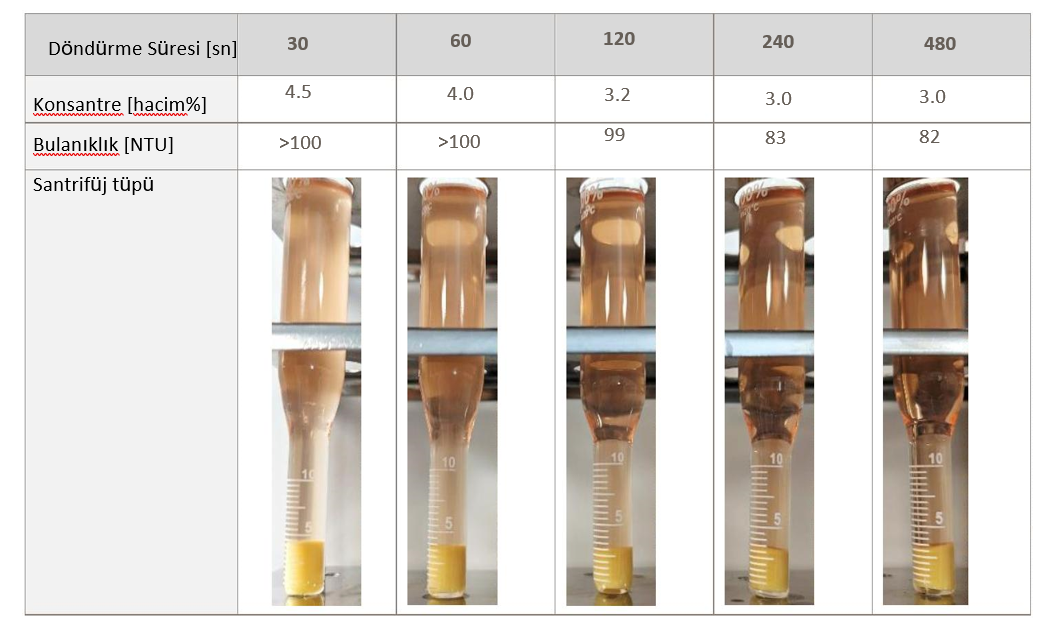
The result of the pre-centrifuge test showed that high cell concentration (= Concentrate [volume %], expressed in Table 1-1 as the ratio of the cell pellet to total volume) and the lowest turbidity could be achieved with longer centrifugation times (for the GEA kytero® 500 this correlates with lower feed rates). However, there are numerous small particles in the raw biomass that can only be reduced to a certain level with higher centrifugation times. Therefore, a target turbidity limit of approximately 80 NTU was set.
No product loss was observed during centrifugation and no adverse effects on the pH value, DNA concentration or product quality of the harvest biomass were detected at the tested parameters. The GEA kytero® single-use separator provides high efficiency and process safety in the cell harvest step and places no limitations in terms of cell biomass quantity. It is therefore an excellent equipment for high-quality and GMP-compliant mass production in the biotechnology and biopharmaceutical industries.
For more information, please visit the website below:
https://gea.com/kytero
Gallery