The sports and entertainment sectors consume energy across a wide range of applications, including movable equipment, grandstand/roof systems and indoor facility operations. Fiber-reinforced composites (CFRP, GFRP, basalt, aramid and thermoplastic composites) reduce mass, dampen vibrations and extend maintenance intervals thanks to their high specific strength-to-stiffness ratio and resistance to corrosion and fatigue, thereby lowering energy consumption and carbon footprint over the service life. Beyond this, composites also serve as the structural material for direct energy generation or storage in applications such as wind turbine blades, wave/hydrokinetic structures, composite flywheels and Type IV pressure vessels for hydrogen.
Sports and entertainment sectors consume energy across a broad range of applications: mobile equipment, grandstand and roofing systems, and indoor facility operation. Fiber-reinforced composites (CFRP, GFRP, basalt, aramid and thermoplastic composites) reduce mass, dampen vibrations and extend maintenance intervals through their high specific strength–stiffness and corrosion/fatigue resistance; this lowers energy and carbon footprint over the service life. Conversely, in wind turbine blades, wave/hydrokinetic structures, composite flywheels and Type-IV pressure vessels for hydrogen, composites serve as the primary structural material for energy generation or storage.
This review compiles: (i) energy efficiency gains in sports equipment and facilities, (ii) applications intersecting energy generation/storage, (iii) life-cycle assessment (EPBT, EoL) and (iv) the design–KPI framework. Through representative cases and numerical insights, it is shown that despite the embodied energy cost of composites, operational-phase savings and energy payback periods (EPBT) remain short in most scenarios. Finally, a roadmap addressing lightweight design, hybrid lay-up and out-of-autoclave processes is presented in light of standards (ISO/IEC) and R&D priorities.
1. Introduction
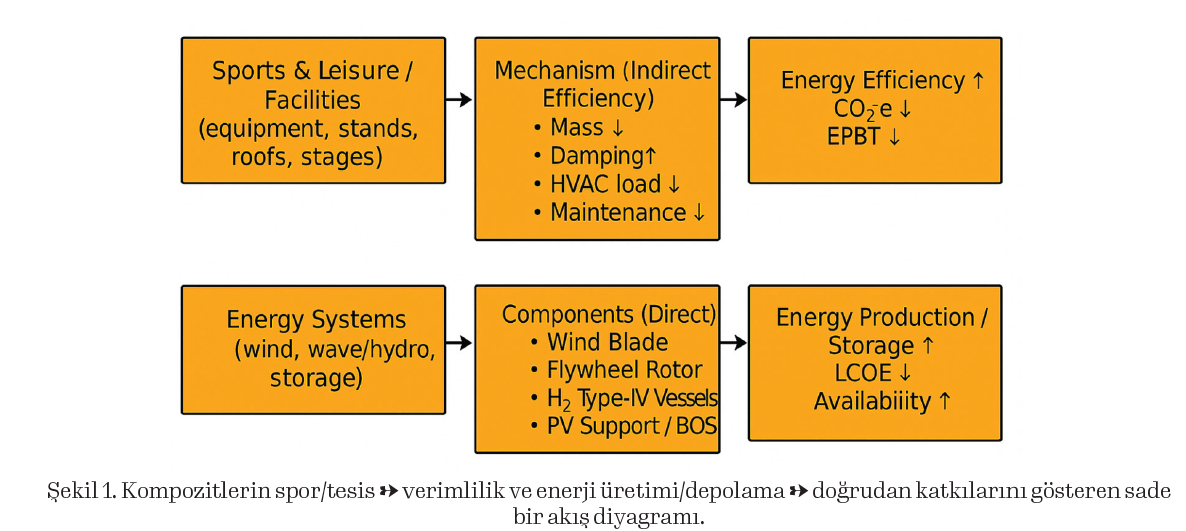
Composites have become the dominant material for mass-critical and fatigue-critical parts in sports and outdoor events. Two main energy axes exist:
1. Indirect gains (efficiency): mass reduction and damping → less mechanical/metabolic or HVAC energy.
2. Direct gains: primary structure in energy generation/storage (wind, wave, flywheel, H₂ vessels).
2. Energy Efficiency in Sports and Entertainment Applications
2.1. Mobile equipment
Mass effect: Energy in climbing/acceleration ≈ ∝ m. CFRP frame/crank/wheelset in bicycles reduces work demand; in rowing, skiing and rackets, performance improves without added fatigue.
Vibration damping: Sandwich structures and z-stitched/core designs → loss modulus increases; musculoskeletal load and energy loss decrease.
Fatigue life: Fiber orientation, high-cycle-life gains → reduced part replacement and manufacturing-maintenance energy.
2.2. Facilities and infrastructure (grandstands, roofs, stages)
Lightweight and insulating panels: Good λ and low mass → reduced HVAC loads (especially pools/indoor halls).
Corrosion resistance: In salt/humid environments, maintenance intervals increase; lifetime energy and CO₂e decrease.
3. Intersections with Energy Generation and Storage
3.1. Wind turbine blades (GFRP/CFRP hybrid): As blade radius R increases, swept area A=πR² grows; power P≈½ρAC_Pv³. Composite spars, by virtue of fatigue and stiffness, enable long-slender profiles → capacity factor and LCOE improve.
3.2. Wave and hydrokinetic systems: Saltwater corrosion → composite floats and foils show extended life and availability versus metal structures; maintenance energy decreases.
3.3. Flywheel (inertial) energy storage: Stored energy E=½Iω². Allowable tip speed ∝√(σ/ρ). High σ/ρ ratio means composite rotors deliver vastly higher specific energy than steel.
3.4. Type-IV pressure vessels for hydrogen: Polymer liner + CFRP wrap → mass decreases, portability increases; fuel system specific energy density rises, transport/logistics energy falls.
3.5. PV module supports and back sheets: Lightweight, low-moisture-diffusion laminates → field durability increases; mounting and BOS labour/energy decrease.
4. Life-Cycle and Energy Payback:
Embodied energy vs operational savings: EPBT=E_embodied/(ΔE_annual savings)
Embodied energy in composite manufacturing (fiber + resin + process) is typically repaid through operational-phase savings within a few years in most applications.
EoL (end-of-life): Thermoplastic matrices (welding/reshaping), solvvolysis/pyro-recovery and fiber reuse pathways improve EPBT and LCA.
5. Design and KPI Framework
Fiber orientation & topology optimization: Fiber aligned with load paths → material and energy waste decrease.
Sandwich core selection: Stiffness/weight increase; vibration and thermal bridges controlled.
Energy reduction in manufacturing: Out-of-autoclave, low-T cure resins, infusion/AFP.
KPIs: (i) kWh savings/product-lifetime, (ii) kgCO₂e/functional unit, (iii) MTBF/maintenance interval, (iv) specific stiffness/specific strength, (v) fatigue life.
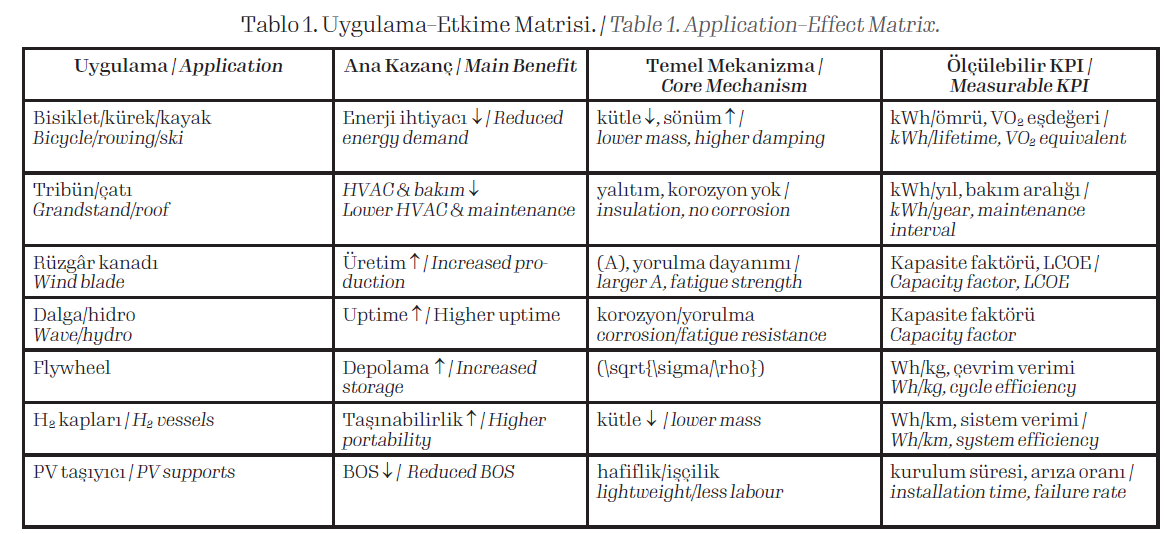
6. Representative Mini-Cases (Numerical Insight)
Bicycle frame + wheelset (−0.9 kg): Potential energy spent climbing mgh decreases proportionally; in racing/amateur use, seasonal savings equivalent to a few kWh are achievable (depending on course and rider power).
Grandstand roof (steel → GFRP sandwich, −25% mass): Lifting winch hours and connection count decrease; HVAC heat gains in enclosed volume fall.
Wind blade (R +10%): A ≈ +21% → with same Cp and wind regime, theoretical P +21%; composite spars meet fatigue limits.
Flywheel rotor (composite): Increase in allowable tip speed multiplies specific energy; efficiency rises in peak-power balancing and regenerative applications.
7. Conclusion and Roadmap
Composites deliver dual benefit: indirect energy efficiency in sports and recreation (mass, damping, maintenance) and direct role in the energy sector as generation/storage component. Near-term, hybrid lay-up, thermoplastic matrices and OOA processes; mid-term, fiber recovery and design-for-disassembly (DfD) approaches will further shorten EPBT. Standards-compliant (ISO/IEC) testing and LCA reporting will strengthen comparability of findings.
Asst. Prof. Dr. Cemil Koyunoğlu
Department of Energy Systems Engineering
Faculty of Engineering
Yalova University
Gallery