Aluminum Recycling's Contribution to Carbon Neutrality Goals

From recovery processes to innovative technologies supporting these processes, aluminium recycling offers numerous benefits for producers, processors and recyclers. TOMRA Recycling Metal Market Strategy Director Frank van de Winkel outlines the current state of aluminium recycling and explains how many sectors can contribute to a more circular economy by adopting state-of-the-art sorting technologies.
Aluminium recycling: a critical solution
At a time of rising environmental awareness and intensifying global sustainability goals, the aluminium industry is emerging as a dynamic force for positive change. As companies race to reduce their carbon footprints and shift towards more sustainable practices, aluminium recycling becomes a critical solution. This versatile metal, found everywhere from beverage packaging to aircraft parts, presents a unique opportunity to conserve resources, minimise environmental impact and improve operational efficiency.
Aluminium has two basic forms: cast aluminium and wrought aluminium. Cast aluminium is characterised by high silicon content, while wrought aluminium contains minimal silicon. When cast and wrought aluminium are combined, the resulting alloy is primarily used in cast aluminium production because there is no simple or commonly used method to completely remove silicon. This process, known as 'downcycling', sometimes produces different products from scrap mixtures.
The source of aluminium significantly affects its composition. Scrap aluminium feedstock can be divided into two main types: post-production and post-consumer. While both categories are important for sustainable applications, they differ significantly in their sources and properties.
Post-production industrial scrap, as the name suggests, is generated during the production process. It typically arises as a by-product or waste in the production of industrial products such as automotive, construction materials and household appliances. This type of scrap is generally pure and unused.
Post-consumer scrap, on the other hand, is generated at the end of a product's life cycle. It is produced by consumers who use aluminium-based products and then discard them. This type of scrap can come from various sources such as appliances that have completed their useful life, homes, businesses and public spaces. Unlike post-production scrap, post-consumer scrap is generally contaminated with various substances such as food residues, dirt and other waste.
Understanding these differences in scrap composition allows recyclers to adapt their sorting and processing techniques accordingly. This ensures that the recycled aluminium meets the necessary standards for various applications.
Challenges in aluminium recycling
One of the biggest obstacles in aluminium recycling is the difficulty of separating alloys once they are mixed from other metals. Given the wide range of cast and wrought aluminium alloys, numbering in the hundreds, it is vital to keep scrap aluminium as close as possible to its original composition or at least to the desired composition of the final product.
Different aluminium alloys have different properties such as strength, corrosion resistance and formability. By identifying the specific alloy of recycled aluminium, recyclers can optimise the recovery process to preserve these valuable properties, ensure efficient and cost-effective processing of the material. This knowledge enables processors to produce recycled aluminium equivalent in quality and performance to primary aluminium, expand its potential applications and increase its market value.
Understanding the source of aluminium is critical to improving recycling efficiency. By identifying potential contaminants or impurities, recyclers can implement targeted cleaning and sorting methods to remove these unwanted materials. This improves the quality of the recycled aluminium, reduces energy consumption and minimises waste.
The power of precise sorting
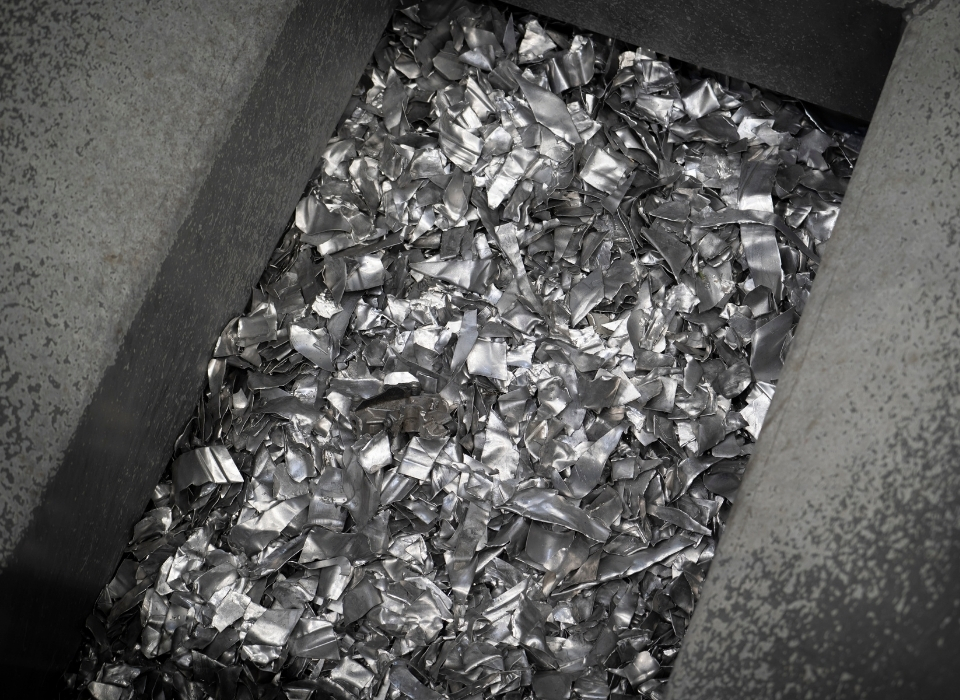
Advanced metal sorting solutions are revolutionising the recycling sector by transforming waste into valuable resources. These sophisticated systems use cutting-edge technologies such as X-ray transmission (XRT), a powerful tool used to sort and analyse materials according to their atomic density, and artificial intelligence (AI) to accurately identify and separate different metals, providing high-purity products.
This precise sorting enables recycled aluminium to be used directly as a replacement for primary material in various industries. From beverage packaging to construction materials and automotive parts, recycled aluminium can be seamlessly integrated into production processes without compromising product quality or performance. This contributes both to the preservation of valuable resources and to the reduction of environmental impact associated with aluminium production.
TOMRA's AUTOSORT™ PULSE machine is a prime example of such a solution. Utilising advanced dynamic laser-induced breakdown spectroscopy (LIBS) technology, this innovative sorting system can rapidly analyse the composition of metal objects and distinguish between different types, grades and even alloys. This closes another gap on the road to complete material circularity, enabling high-yield production of alloy scrap fractions. In this way, it maximises their economic value and opens the door to a more sustainable aluminium supply chain.
Another key advantage of AUTOSORT™ PULSE is its ability to minimise contamination, increasing the value and marketability of recycled materials. The system's precise sorting capability reduces the risk of cross-contamination, preserving the integrity of recycled materials and ensuring they are suitable for their intended applications.
The high purity of aluminium scrap fractions provided by AUTOSORT™ PULSE allows this material to be used in aluminium melting and production processes without compromising the quality of valuable materials. Comprehensive material tests conducted in TOMRA's test centres and at customer facilities have shown that AUTOSORT™ PULSE consistently delivers purity levels of 95 per cent and above.
Looking ahead
Demand for recycled aluminium is growing, particularly in the automotive and construction sectors, as there is a shift towards lighter, more sustainable products. The transition to electric vehicles is further accelerating demand for recycled materials. Government regulations such as the EU's ban on CO2-emitting vehicles and Green Deal targets, as well as industry initiatives, are also increasing demand for recycled aluminium as part of efforts to reduce greenhouse gas emissions and promote a circular economy.
As many countries and regions strive to meet their commitments to achieve carbon neutrality by 2050, the role of recycling in achieving these goals is of great importance. Among various materials that can be sustainably reused, aluminium stands out as a particularly valuable resource. The aluminium recycling process results in significant savings in energy consumption compared to primary production, resulting in significant reductions in carbon emissions.
Key sectors where aluminium is widely used, such as automotive, transport and construction, have a unique opportunity to lead the transition to a circular economy by minimising environmental impact and accelerating progress towards carbon neutrality.
The future of aluminium recycling lies not only in recycling production scrap, but also in replacing primary raw materials with secondary scrap. This requires continuous improvement in processing technologies, particularly for alloy sorting. Some of our customers are pioneering this approach by implementing our advanced metal sorting solutions to facilitate more efficient and precise recycling.
Gallery