Sabri Ülker Foundation Launches "Nutrition and Nutrition Communication" Program

The Sabri Ülker Foundation's "Nutrition Communication" program for pharmacists was launched with a live council meeting broadcast via the social media platforms of the Turkish Pharmacists' Association (TEB), the Federation of Family Physicians Associations (AHEF) and the Turkish Society of Internal Medicine (TİHUD).
Sabri Ülker Foundation's "Nutrition Communication" program for pharmacists began with a live council meeting held through the social media platforms of the Turkish Pharmacists Association (TEB), Family Physicians Societies Federation (AHEF), and Turkish Society of Internal Medicine Specialization (TİHUD).
Sabri Ülker Foundation, established with the aim of reaching correct and scientific information to all segments of society in the fields of nutrition and healthy living, has launched a "Nutrition and Nutrition Communication" program for pharmacists in cooperation with the Turkish Pharmacists Association, following work with family physicians and internal medicine physicians. The opening remarks of the live council were delivered by Sabri Ülker Foundation Chair Dr. Talat İçöz.
Dr. Talat İçöz stated that Sabri Ülker Foundation is celebrating its 15th year this year and has implemented sustainable projects, each being the first in its field since its establishment. He noted that the "Nutrition Communication" training programs, which began with the Family Physicians Societies Federation in 2022 and continued with the Turkish Society of Internal Medicine Specialization, have been accessed by physicians approximately 20,000 times to date. İçöz continued as follows:
"Following the productive outcomes of our cooperation with our physicians, we thought it necessary to include our pharmacists, who are among the most valuable stakeholders of the healthcare system, in the program. We believe that our 10-session program, created for this purpose, will make significant contributions to reaching scientific information to society on topics where information pollution is most prevalent in health and nutrition.
After our training sessions, 96% of our internal medicine physicians and 90% of our family physicians stated that they wanted these trainings to be included in the medical school curriculum. Our ultimate goal through this program is for these trainings to be part of the core curricula of our medical and pharmacy schools, and for our physicians and pharmacists to graduate equipped with nutrition communication knowledge. This realization will mean contributing to public welfare through doctors and pharmacists who communicate face-to-face, eye-to-eye. I hope our call and efforts will find a response."
Prof. Dr. Serhat Ünal: Appropriate communication language contributes to public health
Prof. Dr. Serhat Ünal, who prepared the curriculum for the "Nutrition and Nutrition Communication" program and is a Faculty Member at the Department of Infectious Diseases and Clinical Microbiology at Hacettepe University Faculty of Medicine, Director of the Vaccine Institute, and Member of the Sabri Ülker Foundation Science Board, noted the following: "Physicians and pharmacists, who play a critical role in individuals' lifelong health journeys, are positioned as healthcare professionals obligated to provide their patients with nutrition recommendations that support healthy living beyond their primary duties.
The scientific answers provided by our physicians and pharmacists—who are most trusted for their knowledge on nutrient-drug interactions, nutritional supplements, vitamins, nutrition, and healthy aging—using appropriate communication language will make important contributions to both public health and disease prevention. We believe that our pharmacists, with whom we jointly created the roadmap of our program, will benefit from the training as much as our physicians reporting that pharmacists are applying the skills they acquired from the trainings to practice."
Prof. Dr. Nur Baran Aksakal: Nutrition Education Protects Public Health
Prof. Dr. Nur Baran Aksakal, Member of the Sabri Ülker Science Board, stated: "As with almost every subject, there is incredible information pollution in the field of nutrition. Infodemic is everywhere and on every subject. Every day new claims are made about a food or food supplement being beneficial for healthy living, boosting immunity, or more specifically for chronic diseases such as diabetes and cancer, and even curing them. New diet methods are presented as miracle cures. This information appears in news, on social media, or in other internet spaces.
Medical school curricula do not contain comprehensive nutrition and nutrition communication courses. Those using food supplements also have insufficient knowledge about drug interactions or nutrition regimens that could be beneficial. This makes the development of nutrition education and nutrition communication programs for physicians in this field even more important. For this reason, educating both families and primary healthcare providers—family physicians—on this subject and guiding young people and children on healthy nutrition is of great importance.
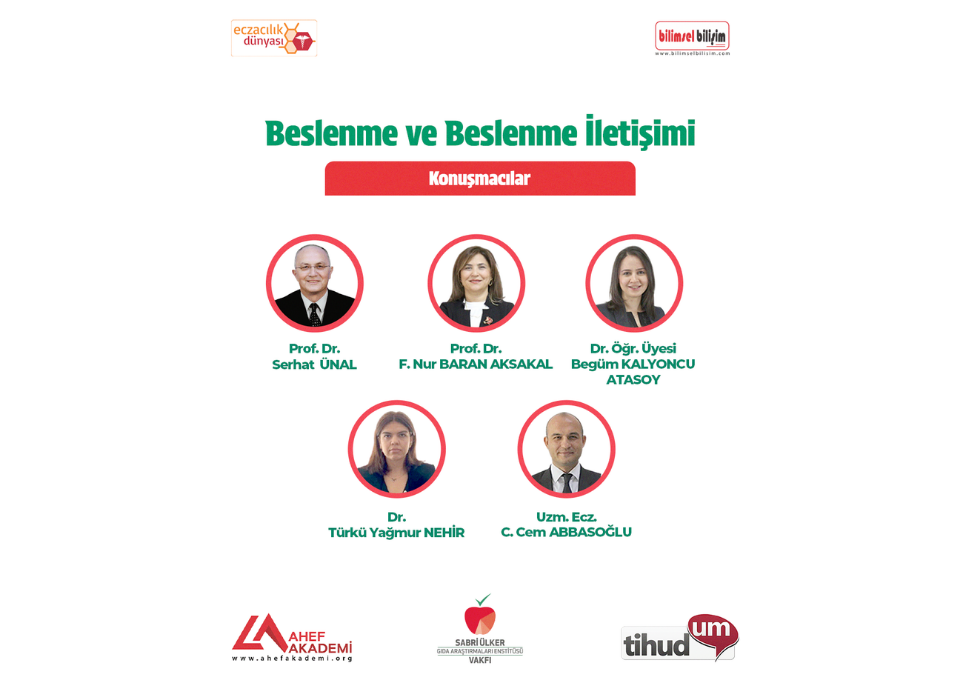
At the meeting opened with a live council session; Dr. Lecturer Begüm Kalyoncu Atasoy from the Department of Nutrition and Dietetics at Ankara Sağlık Bilimleri University Gülhane Health Sciences Institute, Family Physicians Societies Federation Board Chair Dr. Türkü Yağmur Nehir, and Ankara Pharmacists Chamber Chair Specialist Pharmacist C. Cem Abbasoğlu also shared their views with participants. The live council, watched by 1,162 people through the Pharmacy World platform, 1,327 through TIHUDUM, and 1,209 from the AHEF Academy portal, reached approximately 3,700 people.
Training will continue with different topics until 11 November 2025
Following the joint live council meeting, training for pharmacists, beginning with the topic "Nutrition and Healthy Aging," is planned to continue at intervals until 11 November 2025. The "Advanced Nutrition and Nutrition Communication Training" previously launched by Sabri Ülker Foundation for internal medicine physicians will also continue concurrently with the training for pharmacists.
Gallery