
The footwear industry accounts for a significant share of global polymer consumption and is among the sectors most responsive to technological developments. Today, the most critical factor determining a shoe's performance, comfort and durability is the selection of the polymer systems used in it. Across a wide range of materials—from sole components to insoles, midsoles and outsoles—polyurethane (PU), ethylene vinyl acetate (EVA), thermoplastic elastomers (TPU, TPR) and various types of rubber (SBR, NR, BR) play a decisive role.
1. Introduction
The footwear industry represents a significant segment of global polymer consumption and ranks among the sectors most responsive to technological advances. Today, the critical factor determining a shoe's performance, comfort and durability is the selection of polymer systems used in its structure. Across a broad range of materials spanning from sole components to inner linings, interlayers to outer surfaces, polyurethane (PU), ethylene vinyl acetate (EVA), thermoplastic elastomers (TPU, TPR) and various rubber types (SBR, NR, BR) play a decisive role.
The global footwear market is expected to exceed USD 530 billion by 2030, with this growth directly increasing demand for high-performance polymer technologies.
2. Technical Analysis of Polyurethane, EVA, Thermoplastic and Rubber Systems
2.1. Polyurethane (PU) Systems
Polyurethanes are versatile polymers formed through the addition reaction of diols (polyols) with diisocyanates (MDI or TDI), carrying urethane (-NH-CO-O-) bonds in their structure. The flexibility of their chemical architecture allows PUs to be engineered across a broad mechanical range through the ratio of hard and soft segments.
Polyurethane systems occupy a unique position among shoe polymers with the multidimensional technical advantages outlined below:
-Design Freedom: The only material family with adjustable hardness from Shore 15A to 80D
-Superior Mechanical Performance: High tensile strength (10–40 MPa), elongation at break (300–600%) and tear resistance
-Abrasion Resistance: Service life 1.5–3× longer compared to rubber and EVA
-Dual Density Design: Different hardness zones can be created in the mold in a single step
-Chemical Resistance: Superior resistance to oil, solvent and hydrolysis (particularly polyester polyol systems)
-Recyclability: Sustainable cycle through chemical recycling (glycolysis, hydrolysis) and mechanical grinding technologies
2.2. EVA Foam
Ethylene Vinyl Acetate (EVA) is obtained through copolymerization of ethylene and vinyl acetate monomers. EVA foam used in footwear is typically formulated with 18–28% vinyl acetate content and cross-linked with peroxide or azo compounds. In compression molding, blowing agents (azodicarbonamide - ADC) create a sponge structure; cross-linking determines the product's shape memory and mechanical flexibility.
EVA's greatest advantages include exceptional low density in the range of 0.15–0.25 g/cm³, easy molding and low raw material cost. For this reason it has been the standard material in athletic shoe midsole applications for many years. However, EVA has certain critical limitations:
-Permanent deformation (compression set): Irreversible compression under prolonged loading
-Temperature sensitivity: Stiffening at high temperatures, embrittlement at low temperatures
-Abrasion resistance remains limited compared to PU and TPU
-Susceptibility to yellowing and surface degradation under UV exposure
These limitations have increased market interest in EVA-PU hybrid systems; some manufacturers apply PU coating over EVA base layers, creating composite material solutions that combine the advantages of both materials.
2.3. Thermoplastic Elastomers: TPU and TPR
TPU is a thermoplastic elastomer with a block copolymer structure composed of hard (isocyanate + chain extender) and soft (polyol) segments. Its fundamental difference from thermoset PU is the capability to re-melt and reshape. This property provides significant advantages in terms of processability and recycling.
TPU applications in footwear:
-Outsole: In premium and athletic shoes requiring high abrasion resistance
-Overlays and supportive components: Heel counter, toe cap
-Films and membranes: Water-resistant breathable layer (e.g. Gore-Tex lamination partnerships)
-Injection midsoles: High resilience formulations providing advanced energy return
TPU's broad hardness range from Shore A 60 to Shore D 75 allows different functional zones to be designed with a single material. Polyether-based TPUs in particular display superior resistance to microbial degradation and hydrolysis.
TPR (also referred to as TRP) is a thermoplastic elastomer category utilizing SBS (Styrene-Butadiene-Styrene) or SEBS (Styrene-Ethylene-Butylene-Styrene) block copolymers as its base polymer. Offering rubber-like properties without requiring vulcanization, TPR is preferred particularly in low to mid-segment footwear and children's shoes.
TPR's primary advantages are easy processability via injection molding, rubber appearance and feel, recycling ease and low cost. However, abrasion resistance and dynamic performance in critical applications fall short of TPU and PU.
2.4. Rubber Systems: SBR and NR
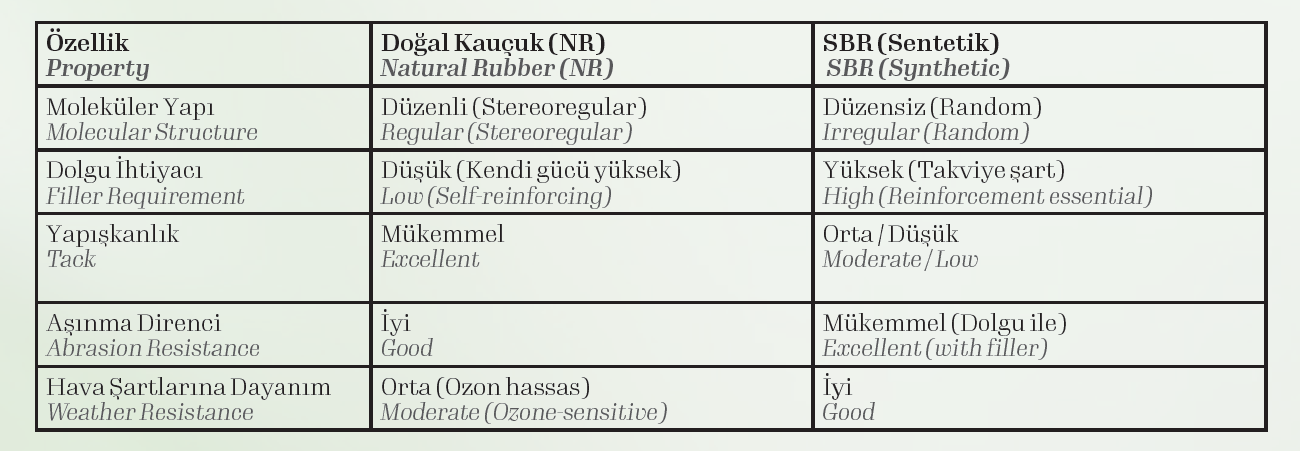
SBR (Styrene-Butadiene Rubber) is the most widely used synthetic rubber type in footwear outsoles. Optimized formulations leverage styrene's contribution to hardness and abrasion resistance with butadiene's contribution to flexibility and low-temperature performance. SBR compounds reinforced with carbon black or silica can achieve values below 150 mm³ in DIN 53516 abrasion testing. Vulcanization system optimization (sulfur dosage, accelerator combinations) has decisive impact on SBR's static and dynamic properties. Silica/TESPT coated systems in particular have delivered significant improvement in wet ground slip resistance through transfer of green rubber technology to footwear.
NR (Natural Rubber), obtained from Hevea brasiliensis source as NR (cis-1,4-polyisoprene), offers exceptional mechanical properties with 93–98% purity and high molecular weight polymer chains. With high energy recovery, low heat build-up and superior tear resistance, NR is preferred in outsoles of premium and athletic footwear. However, limitations in oil and ozone resistance encourage NR use in composite formulations (blends with SBR or BR).
 3. R&D Perspective and Sector Forecasts
3.1 Current Research Focus Areas
R&D activities in the footwear polymers field are structured around four principal axes:
a) Bio-based and Sustainable PU Systems: Substitution of petrochemical-derived polyols with bio-based alternatives (castor oil, soy, sugarcane polyol) reduces both carbon footprint and responds to regulatory pressure. PU sole systems reaching 30–70% bio-based content are currently in pilot production phase. The European Chemicals Agency's (ECHA) proposed restrictions on MDI are also accelerating research into alternative isocyanate chemistry.
b) Lightweighting and Cellular Structure Optimization: Supercritical CO₂ (scCO₂) foaming technology creates nano-cellular structure (<10 μm cell size) in EVA and TPU, delivering 20–30% weight reduction with simultaneous improvement in energy absorption capacity. Adidas Boost (TPU bead foam) and Nike ZoomX (PEBA-based) are commercial applications of this technology class.
c) Functional Surfaces and Smart Materials: Phase change materials (PCM) are microencapsulated and integrated into PU midsole matrix; thereby improving foot climate management. Shape memory polyurethane (SMPU) formulations are undergoing clinical study in specialized orthopedic footwear.
d) Circular Economy and Chemical Recycling: Decomposition of PU into its polyol components via glycolysis and hydrolysis offers promise for obtaining secondary polyols at high purity. Expected to become mandatory post-2030 under the European Green Deal framework, footwear recycling targets are driving commercial prioritization of this research area.
3.2 Sector Forecasts
Over the coming 5–10 year perspective, the following transformations are expected to emerge in the footwear polymers sector:
-PU-EVA integration: Hybrid midsole systems will replace mono-material EVA and single-component TPU sole designs.
-PEBA (Polyether block amide) growth: PEBA foams with rebound rates exceeding 80% will continue to exert pressure on PU and EVA in upper segment running shoes.
-Digital manufacturing integration: 3D-printed lattice structure PU sole designs will enable personalized biomechanical support.
-Regulatory compliance: REACH restrictions on CMR substances, isocyanate dust/fume limits and plasticizer chemistry reformulation will become mandatory.
-Domestic industrialization: Reducing import dependency in PU sole system production in Turkey requires R&D-backed formulation development of critical importance.
4. Conclusion
Footwear industry material technology has advanced far beyond simple sole material selection. Polyurethane systems continue to occupy the apex of the footwear polymers pyramid with unique design flexibility, superior mechanical performance and sustainable recycling potential. When EVA's lightweight advantage, TPU's processability and recycling superiority, and rubber's established friction and abrasion heritage are combined, the sector's future lies not in single material dominance but in intelligently designed hybrid and multi-component systems.
In terms of footwear industry perspective, companies that master PU system chemistry, internalize formulation competency and develop R&D capacity are forecast to gain competitive position in the medium term both in domestic market and along export axes.
Every advance in materials science directly shapes the next generation shoe's comfort, safety and environmental sustainability. This reality establishes polymer R&D as a strategic priority for the sector.
Gallery