In coating systems, surface scratches and micro-scratches are critical degradation mechanisms that directly affect not only aesthetic appearance but also the barrier performance and service life of the coating. This study provides a comprehensive review of self-healing coating technologies in terms of their mechanistic foundations, healing kinetics and relationship with formulation parameters. Microcapsule-based systems, polymer networks containing dynamic bonds and stimulus-triggered approaches are examined comparatively, with particular discussion of healing performance in solvent-based polyurethane systems through the balance between chain mobility and crosslink density. The potential of these technologies in wood coating applications and the key parameters limiting their applicability at industrial scale are also evaluated.
Summary
Surface scratches and micro-scratches in coating systems are critical deterioration mechanisms that directly affect not only aesthetic appearance but also the barrier performance and service life of the coating. This study comprehensively addresses self-healing coating technologies in terms of their mechanistic foundations, healing kinetics, and relationship with formulation parameters. Microcapsule-based systems, polymer networks containing dynamic bonds, and stimulus-triggered approaches have been comparatively examined; healing performance has been particularly discussed in solvent-based polyurethane systems through the balance between chain mobility and crosslink density. Additionally, the potential of these technologies in wood coating applications and the fundamental parameters limiting applicability at industrial scale have been evaluated.
1. Introduction
Coating systems serve to impart aesthetic appearance to surfaces while functioning as a protective barrier against mechanical, chemical, and environmental impacts. However, during service life, friction, impact, and abrasive effects result in the formation of micro-scratches and cracks on the coating surface. These damages not only compromise surface aesthetics but also weaken the barrier properties of the coating, accelerating the ingress of water, oxygen, and chemical agents to the surface.
Traditional approaches require recoating or surface restoration to remedy such damage, which presents disadvantages in both cost and operational time. In this context, self-healing coating technologies that can autonomously or stimuli-controllably restore coating integrity after damage have become an important research area in advanced materials design in recent years.
2. Scratch Formation Mechanisms in Coating Systems
Scratch formation on coating surfaces is related to elastic-plastic deformation and micro-crack initiation resulting from localized stress concentration. Scratching behavior is determined by the combined effect of parameters such as resin chemistry, crosslink density, glass transition temperature (Tg), and film thickness.
Three fundamental behaviors are observed during scratching on coating surfaces:
-Elastic recovery
-Viscoelastic deformation
-Permanent plastic deformation
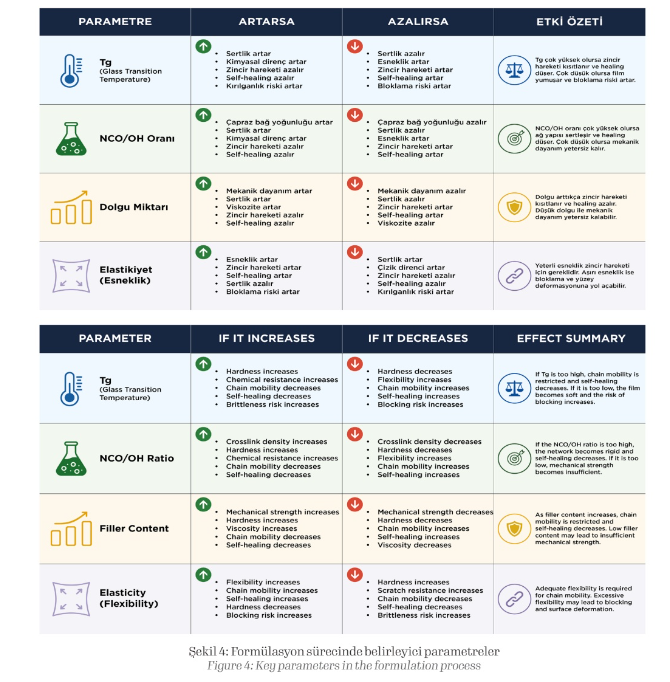
High crosslink density and high Tg values increase surface hardness and scratch resistance while limiting the mobility of polymer chain segments, reducing inter-chain diffusion, and decreasing healing kinetics. Conversely, low crosslink density and increased chain mobility accelerate interfacial diffusion, enhancing self-healing performance, but may result in reduced mechanical strength. This situation presents a critical performance optimization problem in self-healing coating design.
3. Basic Principles of Self-Healing Coating Technologies
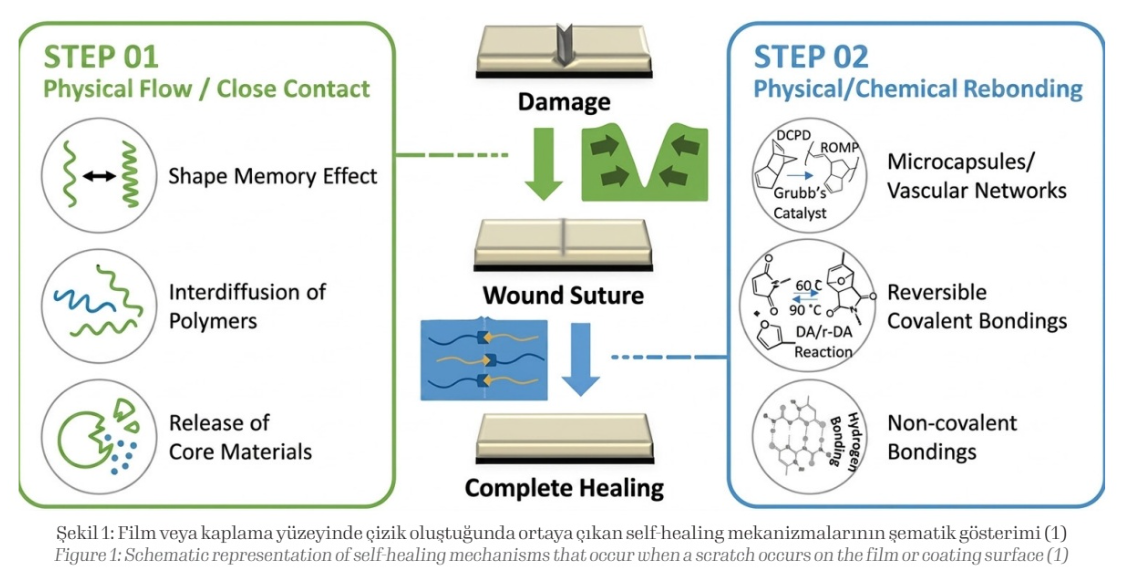
Self-healing coating systems are functional material systems that enable the restoration of coating integrity through filling of voids created after damage and reconstruction of the polymer network. The healing process occurs in two main stages:
3.1 Physical Healing (Void Closure)
Following damage, micro-cracks begin to close through segmental movement of polymer chains. During this process:
-Chain mobility increases
-Interfacial diffusion occurs
-Inter-chain contact is re-established
This stage (Figure 1 - Step 01) is the controlling mechanism that directly determines the rate of inter-chain diffusion and thus controls healing kinetics, and is particularly effective in low Tg systems.
3.2 Chemical Healing (Network Structure Reconstruction)
Following physical closure, the polymer network is reconstructed through dynamic bond mechanisms (2) or capsule-based systems (Figure 1 – Step 02). In this context:
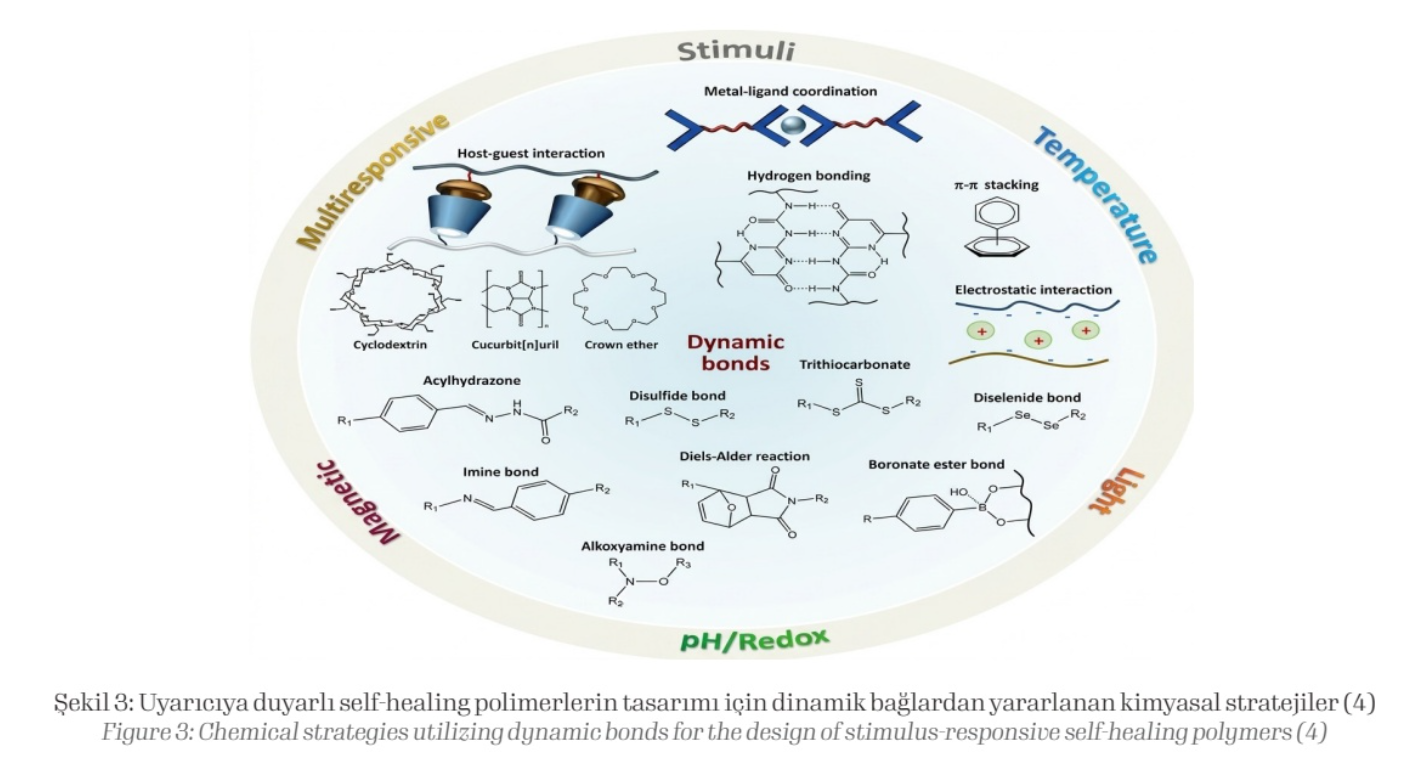
-Dynamic covalent bonds (disulfide, Diels–Alder, boronic ester)
-Supramolecular interactions (H-bond, metal–ligand, π–π)
enable rebond formation in the damage region.
Disulfide bonds in particular, due to their capability to break and reform through redox or thermal activation, provide a repeatable healing mechanism within the coating. These bond dynamics determine not only whether healing occurs but also the rate and efficiency of healing, and are critical parameters.
4. Self-Healing Mechanisms
4.1 Microcapsule-Based Systems
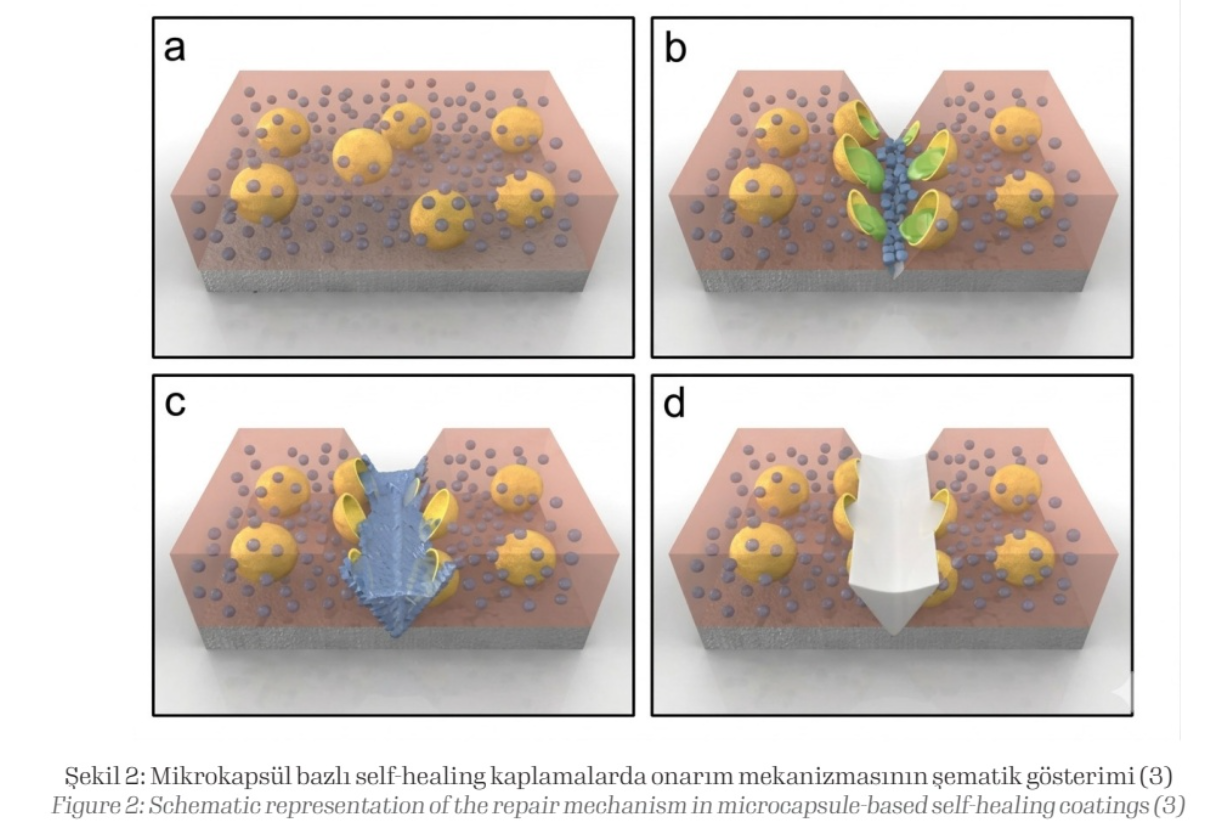
In these systems, microcapsules dispersed within the coating matrix rupture during mechanical damage, releasing the healing agent. The released agent polymerizes in the crack region, filling the void. Although this approach offers autonomous healing advantages, single-use nature and performance variability dependent on capsule distribution are important limitations.
4.2 Dynamic Bond-Containing Systems
In polymer networks containing dynamic bonds, broken bonds can reform depending on environmental conditions. In these systems, healing performance depends directly on:
-Bond energy
-Bond exchange kinetics
-Chain mobility
Such systems offer significant advantages for industrial applications by permitting multiple healing cycles.
4.3 Stimulus-Triggered Systems
In these systems, the healing process is activated by an external stimulus. The most common stimuli are:
• Temperature (thermal activation)
• UV light
• Moisture
In thermally triggered systems, temperature increase accelerates segmental movement of polymer chains, speeding up both physical closure and dynamic bond formation. Particularly in polyurethane-based systems, this approach offers significant advantages in terms of formulation flexibility and ease of application.
5. Industrial-Scale Application and Formulation Challenges
Although self-healing coating technologies show successful results at laboratory scale, various challenges exist in transitioning to industrial applications:
-High raw material costs
-Compatibility issues with existing production lines
-Limited healing efficiency
-Shelf life and stability problems
From a formulation perspective, the most critical parameter is establishing the balance between mechanical strength and healing performance. Particularly in solvent-based polyurethane systems, the use of low Tg segments enhances healing performance while potentially creating adverse effects on surface hardness and scratch resistance.
Key parameters in self-healing coating formulation and their effects on system performance are summarized in Figure 4.
6. Potential of Self-Healing Technology in Wood Coatings
Wood coatings are systems in which surface aesthetics are critical and are highly sensitive to micro-scratch formation. Self-healing coating technologies have the potential to improve coating performance and service life on such surfaces by reducing scratch visibility.
However, in these systems the simultaneous achievement of:
-Transparency
-Surface hardness
-Chemical resistance
is required. Therefore, the formulation development process should be approached as a multi-parameter optimization problem.
Conclusion and Future Perspective
Self-healing coating technologies present significant potential for extending the service life of coating systems and reducing maintenance requirements. In these systems, performance depends not only on the mechanism employed but also on the interaction of parameters such as polymer chain mobility, crosslink density, and bond dynamics.
In evaluating healing performance, quantitative methods such as profilometry, nanoindentation, and healing efficiency are critical alongside FTIR, NMR, rheology, and microscopic analyses (5).
In the future, widespread adoption of self-healing coating systems requires formulation optimization, development of standard test methodologies, and better understanding of long-term durability performance. In this respect, self-healing coating technologies are acquiring an important place within sustainable materials development strategies.
In this context, widespread industrial adoption of self-healing coating systems requires that not only materials development but also process engineering and performance characterization be addressed together.
References
(1) Ahmed et al., "Self-healing polymers for surface scratch regeneration," RSC Advances, 2023, doi:10.1039/D3RA06676B.
(2) Cordier, P., Tournilhac, F., Soulié-Ziakovic, C., Leibler, L. (2008). Self-healing and thermoreversible rubber from supramolecular assembly. Nature, 451, 977–980.
(3) Y. Zhang et al., "Recent advances in self-healing polymers: Mechanisms, materials, and applications," Journal of Materials Research and Technology, 2023, doi:10.1016/j.jmrt.2023.04.032
(4) A. J. R. Amaral and G. Pasparakis, "Stimuli responsive self-healing polymers: gels, elastomers and membranes," Polymer Chemistry, vol. 8, pp. 6464–6487, 2017, doi:10.1039/c7py01386h.
(5) Bekas, D. G., Tsirka, K., Baltzis, D., Paipetis, A. S. (2016). Self-healing materials: A review of advances in materials, evaluation, characterization and monitoring techniques. Composites Part B, 87, 92–119.
Gallery