One of the first names that comes to mind when discussing the chemical industry in Türkiye is Timur Erk…
Report: Gamze Ünal
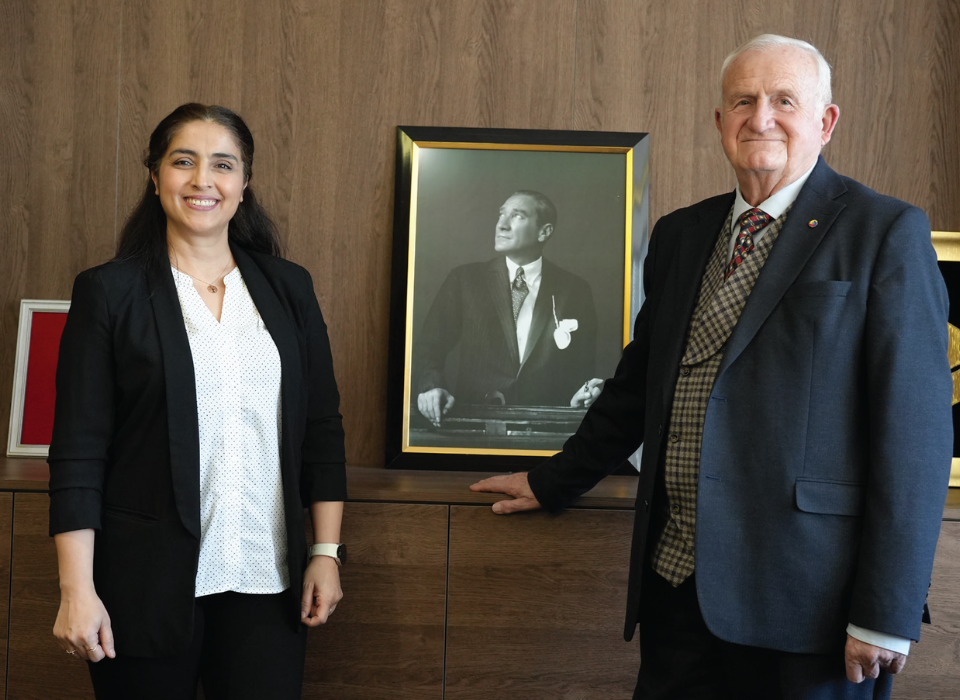
When people think of Turkey's chemical industry, one of the first names that comes to mind is Timur Erk… When he starts talking, you feel as though you are walking through the pages of a book narrating Turkish chemical industry. Born directly into the chemical industry in 1944 thanks to his father's rubber sector company, he later witnessed and participated in the history and development of Turkish chemical industry through his education, experience gained abroad, and investments made upon returning to the country. For this reason, as he puts it, chemistry is encoded in his genetic makeup. Are you ready to embark on a journey through 80 years of successful life with Timur Erk, a doyen not only in industrialization but also in civil society organizations and charitable works?
Could you tell us about yourself, starting from your childhood?
I was born in 1944 and am 80 years old, but my spirit is still young; I feel like I am 60 both physically and mentally. A good mother and father, good education, a good environment, a good spouse, 53 years of happy marriage—when all of these come together, a truly good life story emerges. My father studied in Edirne and later began chemical engineering studies in Germany, but returned without completing them when the war broke out. He completed his education in Istanbul. Subsequently, he worked in the rubber industry. I come from such a father. Chemistry is encoded in our genetic makeup. My mother, although a homemaker, was the eldest of four sons born to a landowner with vast properties and herds of cattle. Thus, considerable heritage was encoded in my mother's genetic makeup as well. Being born and living in a village-like place until age 18 left deep impressions on me. First of all, it was a very cultured environment with Armenians, Greeks, and Turks living together, where Christianity, Islam, and Judaism coexisted, a quality setting with quality people. On top of that, graduating from a good school like the German High School contributed greatly to my development. Back then, there was no distinction between rich and poor children. We would dive into the sea, collect mussels, salt them a bit in a tin can, and eat them with hardtack. Afterwards, we played games like chestnuts and firecrackers in Bebek Garden. Our lives were spent outdoors. Despite some resistance from our teachers, we played plenty of football, one-on-one games, wall ball, long donkey, volleyball—everything. Eventually, someone would get a light bump on the head from a firecracker or chestnut game, we would pause and go home. One of the things I remember most about Bebek is the famous almond paste that is still renowned. Three women took care of me: my mother, my step-sister, and my aunt who lived with us during that period… She was still keen on feeding me well. She would put almond paste in a cloth. When my mother left the house, she would quickly put a piece of candy and almond paste in my mouth. When I was small, I was a chubby child for this reason.
What memories do you have from that period regarding discipline at home and school?
No one could sit at the table until father sat down. No one could start eating until father dipped his spoon into the soup first. Nothing would be left on plates at home. There was no such thing as disliking something. There was great discipline in the house. This is something that greatly affected my life.
In primary school, we had a teacher named Dürdane Hanım. She treated us no differently than her own children. If we did not do our homework, she would line us up the next morning to scold us. "You trust your father's rubber factory, but what if that factory goes under, what if you are left alone in life—how will you manage, my dear? Someone else's father has a restaurant, but what if it is gone tomorrow—how will you manage? Education is the root of everything," she would say, giving us a light caning. In German schools, I learned the most about discipline. Although it was a German high school, we also learned English very well there.
How did you turn toward chemistry?
My father is a chemist. Our immediate upstairs tenant was the General Manager of Bayer Pharmaceutical Factory, a German. On weekends, he would cross the strait alone with a shovel. Then he would return by ferry. That discipline, his love of nature, and his passion for sports left a strong mark on my father. He also saw a person from the pharmaceutical industry as a great role model. He told me, "You will study chemistry like me, but you will complete your chemistry studies in Germany." I, for my part, wanted to travel and flirt, study in more developed cities, bigger cities. I say Berlin—he refuses. Düsseldorf—no. Munich—no. Among the remaining options, he says I will attend Darmstadt Technical University in Darmstadt, a city with 120,000 inhabitants. First, you will study there; second, this neighbor upstairs I mentioned has a brother in Darmstadt who is the General Manager of Deutschebank. He will help you, he said. We learned German so well at German High School that I began competing with Germans there. This was because my father sent me abroad as a scholarship student for three months outside of school. At ages 15, 16, 17, during summer, I became familiar with and accustomed to the environment where I would study. Subsequently, I had a successful education. Then my father said, come back immediately—work there, earn money and gain experience. I received two years of training on adhesives in a German factory. In my second year, my father suffered a sudden stroke and I rushed back to Turkey, and military service became my fate. For this reason, my doctoral degree remained incomplete.
So you had to take over the family business…
Yes, but that business could not continue for long; it was a small manufacturing plant. My father eventually had to close it. After my military service, when I asked my father what I would do, Istanbul University Rector Nazım Terzioğlu said to me: "You have now received the best technical education in Germany. Now you need to graduate from a university in Turkey as well. I will give you a minor partnership with a ruined, uneducated Kayserian. You will get your second diploma working alongside him. You will learn how businesses are driven to ruin, how they are run, and how to make money without money," he said. Believe me, we had a total of 35 years of partnership; he is like a second father to me. Thanks to him, I learned about Turkey and how to conduct industry in Turkey. More importantly, he said, "Even if you are a master, there is a shadow beneath you—look not only to earn money but also to help those around you. Try to give your brainpower." I partnered with a Kayserian who was ruined and uneducated but extraordinarily intelligent, with that true Kayserian cunning. Thus, I entered life with both good academic education and good experience. We produced the first synthetic resin ever manufactured in Turkey. In Turkey of those times, in the 70s and 80s, you could sell whatever you produced as long as you produced it. Raw materials for paint factories, resin for textile processors—we learned to make money in a truly pleasant environment.
Your entry into chemistry coincides with beginning charitable work in the same period…
Yes, my father and Nazım Terzioğlu had a summer house in Silivri that they built. It was called Professors' Site. My father and Nazım Terzioğlu built this site together with six professors. One of the professors was the teachers' teacher and also my father's teacher, Prof. Dr. Ali Rıza Berkem. He said, "My boy, you have become a good industrialist, but you must also help the chemical industry. Let's establish the Turkish Chemical Manufacturers Association, and you be one of its founders." We established the Turkish Chemical Manufacturers Association in 1985, and I began working as vice president. I served as vice president until 2000 and as president until 2021. Then I passed it on to a younger colleague, Haluk Erceber. Shortly after, they made me Honorary President. But I still have not distanced myself from the chemical industry. For 19 years now, I have been serving as the Chairman of the TOBB Chemistry Industry Sector Council. Because of all this, they call me a doyen in the chemical industry.
How do you think Turkish chemical industry can increase its share in the world?
First, I must say that our potential in this regard is high. Geographically, we are in a very good position. We must use our advantage of being in the center well. Along with this, our education system must be very good. Unfortunately, rote-based education does not serve us Turks well. We are now in the digital age. We must embrace the digital environment. We must return to the old undersecretariat era. Undersecretary means the most expert person of that ministry. Starting as a civil servant, climbing the ranks step by step, doing all general directorates, and finally becoming the CEO of the state's ministry. He is not a politician but knows the subject very well. Therefore, there is benefit in reinstating undersecretary positions. It should return with a modified, updated, and digitalized version of the old system. Besides this, the State Planning Organization should also be reinstated. We need a system to carry out urban planning, agricultural planning, and international strategic planning. Also, without investment, without production, nothing is achieved. The investment climate must be improved urgently. With such reforms, Turkey can make a great leap forward.
What do you recommend to young people pursuing careers in the chemical industry?
Those with means must not—I warn you—decide on an investment by asking artificial intelligence or Google. Experience is essential. They must definitely have the feasibility of their investment examined by an experienced person. But before all this, they must receive a very good education. We no longer need someone who is simply a high school graduate, has read university, and become an engineer. We absolutely need people who have completed their doctorate in their own field. We need people who can conduct R&D, or at least have learned these subjects very well and can manage them. It would be beneficial if they do not only chemistry but also take a master's in business alongside. We industrialists must also support our children through scholarship assistance. It would be beneficial for them to read the life stories of experienced industrialists and see what they did right and wrong. In my books too, there are instances where I say I did wrong here, I would do it this way with my current mind.
Finally, we would like to hear your views on 2025 and the future.
There is a recession at the international level. Demand has shrunk. There are two wars in the world, and both affect us. Our exports have begun to decline. There is a suppressed currency being kept stable. We buy our raw materials in euros and try to sell in dollars. We set our costs in Turkish lira. Our costs are rising, so we fall behind in international competition. Turkey's PMI has been below 50% for a long time. There are also CDSs. Five-year credit default swaps measure the credit rating of your currency. They affect your ability to borrow credit. We are good on that, but we still haven't fallen below 200. For this reason, we cannot get cheaper credit from abroad. In an economic environment where all parities favor us, with well-educated youth and strong investments, I wish for Turkey to be a country that moves forward to the future healthily.
Gallery