Chef Serkan Bozkurt
Chef Serkan Bozkurt
Chef Serkan Bozkurt was born in Istanbul in 1980. He studied at Bolu Mengen Anatolian Culinary Vocational High School, Tekirdağ Anatolian Tourism and Hospitality Vocational High School, Food and Beverage Management at Ege University, and Business Administration at Anadolu University.
Throughout his professional career, Chef Serkan Bozkurt has worked in numerous prestigious hotel chains and has experience in Michelin-starred restaurants in Europe. He has also held chef positions at several international restaurant groups.
As a member of the Turkish National Culinary Team, Chef Serkan Bozkurt has achieved success in bringing numerous medals from competitions organized by the World Association of Chefs. He won the award for Europe's best young chef in 2005.
Since 2003, Serkan Bozkurt has produced various cooking programmes on several television channels, written three cookbooks, and contributed food writing to various national newspapers. In 2011, the accomplished chef entered the education sector and continues his work through Chef's Table Culinary Academy, which he founded.
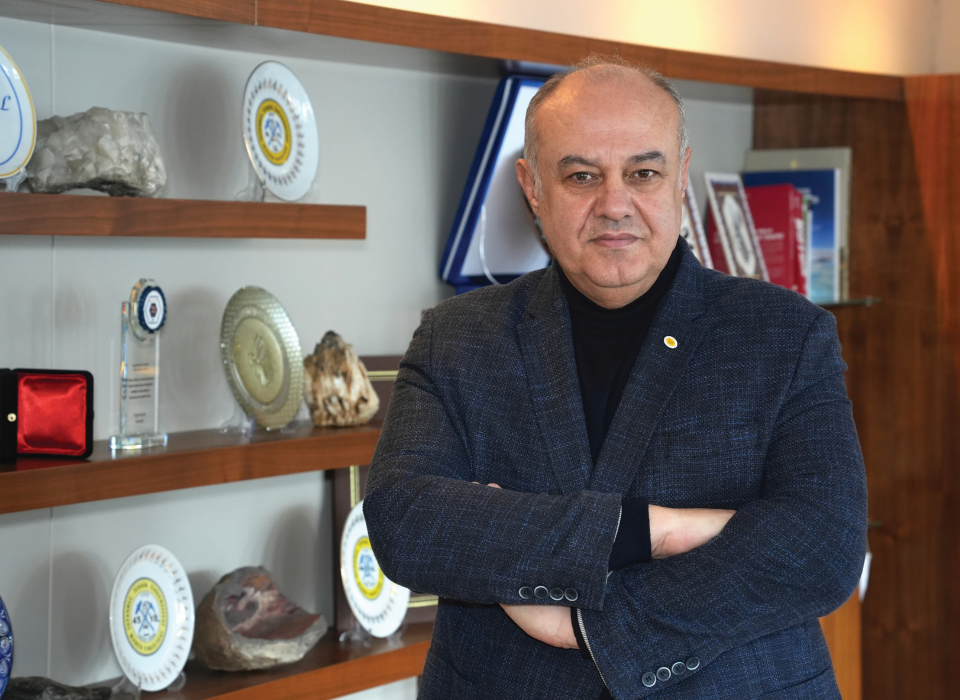
[caption id="attachment_155153" align="aligncenter"] Chef Serkan Bozkurt[/caption]
What do you think is the secret to successful and delicious food? What do you pay attention to in your ingredient selection? What are your aroma preferences?
The most fundamental aspect of successful and delicious food is understanding technique. You may have excellent ingredients on hand, but if you lack proper technique, ultimately those ingredients will not reach their full potential. That is the first point. Of course, experience is extremely important alongside technique. Because when applying technique, you need to maintain it at the level it deserves through experience. That is why this work is really both theory and practice. We could say it is half and half—when one side falters, you see the other side becoming disproportionately stretched, and it simply does not settle properly. The kitchen is truly mathematics, I compare it quite often. You need to calculate well, set things up well, and identify your target audience well. Ultimately, we see food as concrete data, but food preparation is actually the final point of that process—it is a product. The hierarchy, structure, and mathematics of that product from beginning to its materialization are very important. Food cannot be thought of as simply putting these ingredients in and adding the others. You add a material that will provide an excellent and valuable aroma, but if the reactions within it and techniques are not appropriate, that material may not find the flavour it deserves and may not perform as desired. Measurements are very important in cooking, especially in pastry work. In pastry work this is very pedagogical—for example, if you put 60 grams of egg when you were supposed to put 50 grams, there will definitely be a change in the structure. In cooking, there may be some room for adjustment, but there are still upper and lower limits. In short, the secret is correct technique, correct timing, and correct ingredients. In ingredient selection, of course it is important that the food we grow or a product we purchase reaches the desired point of maturation, value, and capacity that it deserves. For example, let us take the tomato. Really, the aromatic flavour you want to contribute to the dish must first reach a level where it can be added at the emphasis you desire, so that when you add it, you get that result. That is why this is very clear—you look at the aroma of the ingredient, you look at its ripeness, and you decide based on this scope. You would not want to use a very hard component with no aroma. Technology, agriculture, and industry have now brought accessibility to many products for 12 months. Of course, this is possible not through the sun's own efficiency or the soil's own cycle in a natural way, but through greenhouses or certain operations. One of the most important matters in a chef position or in the kitchen is using the right ingredient at the right time. The answer here is actually quite straightforward—ingredients used in their season are more aromatic, more delicious, and can produce products that will have more positive health effects. The equivalent of timing is actually the seasonal cycle. Beyond that, we must not forget the cost factor. A product that is not in season is a product created through continuous work and expenditure, so it is much more expensive than one that is produced naturally on its own. That is why we try to prefer using products in their season so we can establish an ideal margin from a nutrition, health, and cost perspective. A professional chef cannot have a specific aroma preference. For example, you cannot serve the same product to guests from two different countries and cultures. Just as a master carpenter or furniture maker takes measurements and carries out the requested work according to those measurements, a chef must present the guest's satisfaction within the desired framework. If you bring emotion and personal preference to the forefront, you automatically step outside your guest's wishes. You can use all general edible aromatic ingredients. But depending on the situation, depending on the concept, depending on the purpose, it changes—that is, it is like tailoring. You listen to the aim, the goal, and the desire, and then you write, sketch, and try to create the product accordingly.What are the fundamental elements that distinguish Turkish cuisine from other cuisines? What are your favourite dishes to make and eat from Turkish cuisine? Can you give a few examples of flavours from world cuisine that you also enjoy?
I am someone who has practised my profession across very different geographies, from America to Australia. I have cooked in Chicago and Melbourne and have seen many cultures and their cuisines. I have represented our country in nearly 25 countries. In my view, the most fundamental characteristic that distinguishes Turkish cuisine from other cuisines is that we make delicious food. Flavour is important to us—wherever you go in our country, beyond presentation, the deliciousness of the food itself and the pleasure of eating it are at the forefront. Of course, in terms of globalization, market share, and market portion, we also place great importance on the presentation of dishes, but our people do not like to eat tasteless food. We have a cuisine that brings together many different cultures layered and added to one another in a very profound way. For example, even if we eat dried beans, we want to eat delicious dried beans. But when you look at other world cuisines, you see that even dried beans floating in water are consumed at breakfast. As a culture, as refined people who have grown up with home food, our people do not accept such food. It must not be forgotten that the concepts of flavour and taste are not very much related to education. Even a baby has its own palate. It spits out things it does not like and eats things it does with appetite. When you put a morsel in your mouth, if it does not fit your own world, that food loses its meaning at that moment. In conclusion, the most fundamental characteristic that distinguishes Turkish cuisine from other cuisines is, in my view, the making of delicious food. Personally, I am someone who loves home food very much. I particularly love eggplant—I love stuffed eggplant, eggplant kebab, eggplant dish, eggplant salad, everything. Eggplant is at the top of the vegetables most eaten in Turkish cuisine, and Turkish people love eggplant very much. But generally speaking, I am not a picky eater. That is why I love our cuisine so much. But I also deal with all world cuisines due to my work and make different recipes. I certainly enjoy cuisines from other regions, but those that appeal to my palate. I also very much love Mexican cuisine because it has many aspects similar to ours. For example, we love sautéed meat, and this exists in Mexico. I also very much love Chinese cuisine—they synthesize very well, somewhat different from our cuisine. For example, sharper flavours are used much more. I give the example of wasabi, the pungency of that wild radish, or ginger—I love it very much. Vinegars, vinegared dishes are beautiful, meats are cooked differently there for our taste, seafood cooked with the tempura frying method is very good. In short, because we love flavour so much, I really love everything that is delicious.What can you point to as the most extraordinary flavours in Turkey?
Really, we are so rich in this regard that we even make jam from watermelon rind. From products we perceive as vegetables, for example, eggplant has jam, tomato has jam. There is even jam made from tender walnuts, pine cones, bitter orange peel, and green figs. Kaymak (clotted cream) is very valued in our cuisine, there is dried kaymak, and there is crispy tarhana (fermented grain paste). We live in an incredibly rich kitchen and culture geographically. In Turkish cuisine, the most beautiful desserts—think about it—are kadayif and baklava, which are dough as raw material but ultimately can be turned into desserts. The list does not end. Turkish cuisine is technically a very developed cuisine. In my opinion, aşure is a world marvel of a dessert. An extremely rich dessert that contains all grains, dried fruits, and nuts within it, and it is one of my favourite desserts—I love both making and eating it.You mentioned that we are a society that has grown up with home food—do you think there is a cook in every home in Turkey?
We have a table culture, we are experienced with pot food, we love eating as a family—that is, we have a culture in which food is cooked at home. This does not really exist abroad; their general structure, family cultures, and lifestyles are different. They generally consume food that will be prepared quickly or will be accessible, without much time being spent. Regarding the question of whether there is a cook in every home, cooking as a profession is a concept like this. I give an example—taking a walnut and turning it into a chip, an ice cream, a dessert, meaning making different innovations and adding value—that is cooking or pastry work. A chef is someone who practices this as a professional value-adding job. A chef buys an ingredient for X lira and transforms it to be sold for 10X lira. Then there is cooking, a person who cooks in their own context—yes, they are a cook in their own right, but technically they are actually a cook, a good cook. When the word chef is used, it should be someone who has made it a profession, someone who continuously produces added value. We, however, are a country with many good cooks and have an amazing cuisine. Cooking is a technique—really, neither theory without practice nor practice without theory is viable in the kitchen in terms of productivity. The more you enter the kitchen mathematically, philosophically, and technically, the more you enter a long path. It is a path without end. From one perspective, one might think there are so many packaged products, recipes, and ingredients, but just as one does not become a poet by memorizing poems, cooking professionally is not done through memorization. Cooking should be characterized as the art of creating added value.Advertisement
Ad Space728 × 90